Heat, Cook and Light Your Home Off-Mains, Safely
Last updated: 21 October 2026
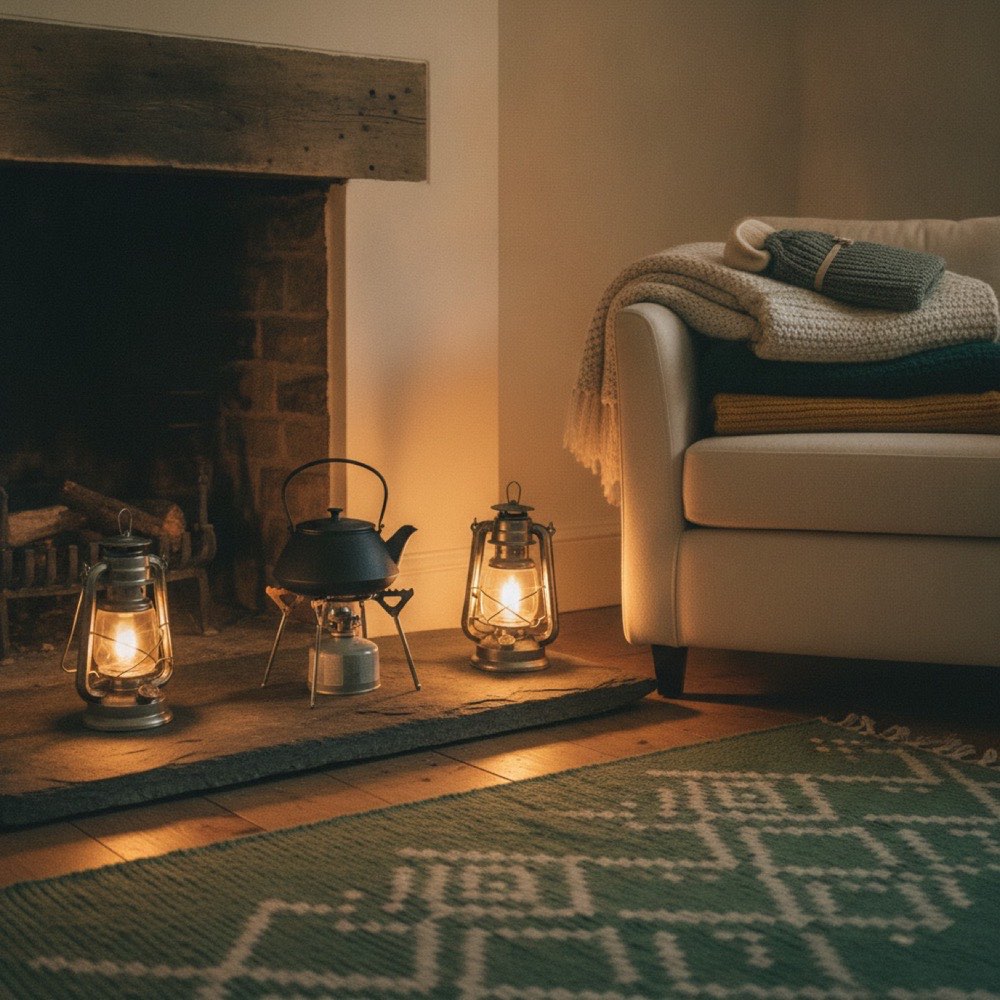
When the power goes off, three jobs matter: staying warm, eating properly and being able to see. All three can be done well in an ordinary UK home, and all three can be done dangerously. The difference is almost never the kit. It is whether you respect one invisible hazard, carbon monoxide, and whether you prepared before the lights went out rather than after. This guide sets out the honest hierarchy for each job: what to do first, what is genuinely safe indoors, what is never safe indoors under any circumstances, and the small number of products that earn a place in a British home. Every safety rule here is drawn from official UK guidance, which is linked at the end, because on this subject nobody should be taking a website's word for anything.
The rules that are not negotiable
Before any discussion of stoves, heaters or lanterns, the carbon monoxide rules come first, because they are the reason people die in power cuts. Carbon monoxide is produced whenever a fuel burns: gas, charcoal, petrol, diesel, wood, paraffin. You cannot see it, smell it or taste it. The NHS lists its early symptoms as headache, dizziness, feeling sick, weakness and confusion, which are easy to mistake for tiredness or a winter bug, and which get worse the longer you stay in the affected room.
These rules are stated plainly in official UK guidance and they have no exceptions:
- Petrol and diesel generators are never used indoors. Not in a garage, not in a conservatory, not in a shed with the door open, not near an open window or air vent. Government guidance for households says a generator belongs outdoors, at least six metres from the building, with the exhaust pointing away from doors and windows. A generator running in an enclosed space can kill in minutes.
- Barbecues and camping stoves designed for outdoor use are never brought indoors. That includes tents, caravans and awnings. UK fire service guidance is explicit that opening tent flaps or windows is not enough to stop carbon monoxide building up, and that an extinguished barbecue keeps producing carbon monoxide for hours afterwards. A cooling disposable barbecue carried inside for warmth has killed people in this country.
- Portable gas heaters are used only exactly as the manufacturer instructs, which means the stated minimum room size, the stated ventilation, never while sleeping, and never in bathrooms or small sealed rooms. If you cannot meet the instructions, you do not use the heater.
- Every home that burns any fuel needs a working carbon monoxide alarm certified to BS EN 50291, the British Standard for domestic CO alarms. This is already the standard required by building regulations when solid fuel appliances are installed in England and Wales, and landlords in England must fit one in any room with a fixed combustion appliance. If you own a gas hob, a log burner, an open fire or any portable fuel-burning kit, an alarm to this standard belongs in the room where the fuel burns. Test it monthly. During a power cut, when improvised heating and cooking appear, it matters more than ever. A certified CO alarm to BS EN 50291 costs less than a takeaway and lasts up to ten years.
If your CO alarm sounds, or people in the house develop headaches and dizziness that ease when they go outside, get everyone into fresh air, stop using every fuel-burning appliance, and call the Gas Emergency line on 0800 111 999 if gas is involved. The NHS says to call 999 if anyone is struggling to breathe, confused or losing consciousness.
Everything that follows sits underneath those rules. A method that fails them is not an option, however cold the house gets.
Keep warm: retain heat before you make heat
The honest truth about heating a room without electricity is that the best first move produces no heat at all. A typical British home loses warmth over many hours, not minutes, and in most winter power cuts the job is to slow that loss rather than replace a central heating system. Trying to heat a whole house with portable kit is how people end up taking risks with fuel indoors.
The one warm room strategy
Choose a single small room and defend it. A smaller room with few external walls holds warmth far better than an open plan living space. Then:
- Close every door in the house to stop warm air migrating.
- Close curtains and blinds everywhere once the light fades. A surprising share of heat leaves through glazing.
- Block draughts under the chosen room's door with a draught excluder or a rolled towel.
- Bring everyone, pets included, into that room. Bodies are small heaters, and several of them in one small room make a real difference.
- Hang a spare blanket or duvet over particularly cold windows if the cut runs long.
Warm the person, not the air
Layers beat heaters. The order that works is a wicking base layer, then insulating mid layers such as fleece or wool, then something windproof if the house is genuinely cold. A hat indoors feels odd and works well. Hot water bottles, filled from water boiled on a safe stove or kept hot in a flask, are one of the oldest and best off-mains heating technologies in existence: heat delivered directly to the person, with nothing burning in the room.
Sleeping bags, rated honestly
A proper sleeping bag turns a cold night in a cut from miserable to comfortable. The number that matters is the comfort rating, not the extreme rating. The extreme figure on the label describes survival for a few hours, not sleep, and buying on that number is the classic mistake. For UK indoor use in a winter power cut, a bag with a comfort rating at or below freezing gives generous margin, because even a cold house rarely drops near outdoor temperatures. Good four season sleeping bags from established outdoor brands are a one-off purchase that also covers camping, guests and car breakdown kit.
Safe heat sources, and the ones that are not
If you do add heat to the room, the hierarchy looks like this:
- Safest: an existing, properly installed and swept solid fuel stove or open fire. If your home already has one, serviced and with a CO alarm in the room, it is the best off-mains heat a British house can have. A power cut is not the moment to light a fireplace that has sat unused and unswept for years.
- Acceptable with discipline: a portable gas heater used exactly to its instructions. Modern cabinet heaters and indoor-rated portable gas heaters state a minimum room size and ventilation requirement, and the better portable units include an oxygen depletion sensor that shuts the gas off if air quality falls, plus a tip-over cut-out. Those safeguards are why such heaters can be sold for indoor use, and they only hold if the instructions are followed: adequate room volume, a source of fresh air, never left running while you sleep, never in a bathroom, and a BS EN 50291 alarm in the same room. Fuel cylinders are fitted or changed outdoors or in a well-ventilated space, never near a flame.
- Never: anything designed for outdoor use. No barbecue of any kind, no patio heater, no fire pit, no camping stove pressed into service as a heater, no generator anywhere inside or in an attached garage. The fire services are unambiguous on every one of these, and this list is where the fatalities come from.
One more quiet rule: a gas oven left open is not a room heater. It is an unattended flame in a power cut with distracted people and candles about, and prolonged use in an unventilated kitchen builds combustion products you do not want. Heat the person, defend one room, and treat added heat as a bonus rather than the plan.
Cook: the safest meal is the one you prepared before the cut
Cooking follows the same honest hierarchy as heating: the best options involve the least flame, and the genuinely safe flame options come with rules attached.
First: boil water before you need it
Most UK power cuts come with warning, either a named storm or a supplier notification. The single highest-value move costs nothing but five minutes: fill one or two large stainless steel flasks with boiling water before the power goes. A good flask keeps water hot enough for tea, instant meals, pot noodles, porridge and hot water bottles for many hours. Two litres of pre-boiled water removes the need to light anything at all for the first day of a typical cut. A large stainless flask is the least glamorous and most used item in a sensible power cut kit, and it earns its keep the other fifty one weeks of the year too.
Second: meals that need no cooking
A short shelf of no-cook food turns a blackout evening into an inconvenience rather than a problem: bread and spreads, tinned fish, cheese, fruit, oatcakes, long-life milk, tinned puddings. If your gas hob stays usable in a power cut, remember that many modern hobs have electric ignition, so a box of matches in the kitchen drawer keeps it available (light the match first, then open the gas). Our guide to the best emergency food supply for UK homes covers building that shelf properly without drifting into bunker territory.
Third: the butane bistro stove, used by the book
For actual cooking off-mains, the portable butane cartridge stove, the flat suitcase-style unit sold for camping and catering, is the most practical tool for a British household. It boils a kettle in minutes, simmers properly, and the cartridges are cheap and widely available. It is also a fuel-burning appliance, so the rules come from the manufacturer's instructions, not from habit. Taking Campingaz's published instructions for its Camp'Bistro stoves as the reference:
- Use it in a well-ventilated space. These stoves are approved for use with ventilation, not in a sealed room. Open a window. If you cannot ventilate, you use the flask and the no-cook shelf instead.
- Respect the pan size limits. Campingaz specifies nothing smaller than 12cm or larger than 26cm in diameter, and no griddles, planchas or stones. An oversized pan reflects heat down onto the cartridge compartment, which is how these stoves end up in fire investigation reports.
- Use only the cartridge the stove specifies, seated correctly. A mis-seated cartridge leaks, and you will hear a hiss and smell gas. If a safety device ejects the cartridge, do not refit it until the stove has fully cooled.
- Fit and remove cartridges away from any flame, preferably outdoors, and always remove the cartridge for storage and transport.
- Never use it as a space heater, and never run two stoves side by side under one large pan.
A portable butane stove with a pack of cartridges costs about the same as a family takeaway and will see you through years of power cuts, camping trips and garden use, provided those rules travel with it.
Outdoors: the barbecue and the camping stove
Charcoal and gas barbecues, and camping stoves built for outdoor use, remain excellent power cut cooking tools in exactly one place: outside, in open air, away from the building, with the cook staying with them. They come back indoors only when fully cold, and never for warmth. If you run a generator for other reasons, the same government rule applies: outdoors only, at least six metres from the house, exhaust away from openings.
For how cooking fits into the wider plan, including water, fridges and freezers, see our guide on how to prepare for a power cut.
Winter fuel realities: cold cartridges and legal storage
Two practicalities catch people out in exactly the conditions when off-mains cooking matters most.
Butane does not like the cold
Standard butane stops vaporising well as the temperature approaches zero, which means a cartridge stove that roared in August can gutter and underperform in a January power cut if the cartridges have been sitting in a frigid shed or car boot. The fixes are simple. Store the cartridges you intend to use at indoor temperature, not in the garage. If you cook outside in winter, keep the spare cartridge in an inside pocket until the moment you fit it. And when buying fuel for winter use, look for cartridges and canisters sold as butane propane mixes or isobutane blends, which keep their pressure at lower temperatures than pure butane. None of this changes the safety rules. It just means the stove actually works when you need it.
Storing fuel at home, safely and legally
A power cut plan is not an excuse to turn the understairs cupboard into a fuel depot. The UK rules are clear and worth knowing:
- Petrol: households may store up to 30 litres without notifying anyone, and only in approved containers: up to 10 litres in approved plastic containers, up to 20 litres in approved metal ones. Fire service guidance is blunt that petrol must never be stored in living accommodation. It belongs in a garage or outbuilding away from the house, and most homes without a generator have no reason to store it at all.
- Gas cylinders: Calor's published guidance is that butane cylinders for portable heaters may be kept indoors in limited quantities, stored upright, away from heat and away from exits, while propane cylinders are stored outdoors only. Keep the absolute minimum you actually use.
- Butane cartridges: the small CP250-style cartridges for bistro stoves store easily and safely in modest numbers: upright, cool, out of sunlight, away from the cooker and boiler, and always detached from the stove. Half a dozen cartridges covers days of careful cooking.
- Never decant, never improvise. Fuel stays in the container it was sold in.
The quiet principle behind all of this: store little, store it right, and let the flask and the no-cook shelf do the heavy lifting so that fuel is a small part of your plan rather than the centre of it.
Light: batteries first, candles last
Lighting is the easiest of the three jobs to get completely right, because the safe option is also the best option. Battery light is brighter, steadier, safer and cheaper to run than flame, and there is no hierarchy debate to have: London Fire Brigade attends roughly 270 candle fires a year in the capital alone, and its standing advice is to reach for torches and battery lighting rather than candles, keeping a torch on every floor in a place everyone knows.
The three-layer light plan
- A head torch for each adult. This is the single best lighting purchase for a power cut, because it puts light exactly where you are looking and leaves both hands working: for the fuse box, the stove, the stairs, the baby. Quality rechargeable head torches from the established torch makers run for many hours on a low setting and take minutes to top up from a power bank.
- A lantern for each occupied room. A good LED lantern lights a whole room evenly in a way a torch cannot, turns a blackout kitchen back into a kitchen, and modern rechargeable models meter their output over a long evening. One rechargeable LED lantern in the warm room and one in the kitchen covers most homes; models that also charge from standard batteries or a power bank remove the single point of failure.
- Stored power to keep it all going. A charged power bank keeps phones and head torches alive through a long cut. For households that see regular or lengthy outages, a compact portable power station adds mains-socket charging for lanterns, phones and a router, silently and with nothing burning. It is the only kind of generator that belongs inside a house.
On brightness claims, treat big lumen numbers on listings with suspicion. A lantern's useful measure is how long it holds a genuinely usable light level, and reputable brands publish honest runtime figures at each output setting. A lantern that gives a steady medium output all evening serves a family better than one that is briefly dazzling.
If you do use candles
Candles are the lighting of last resort, not ambience for a blackout. If they come out at all: one sturdy heat-resistant holder on a stable surface, well away from curtains, decorations and anything above them, never left unattended even briefly, never used to light the way to bed, and always out before sleep. Keep children and pets away from them entirely. Battery LED candles give the same glow with none of the risk, and the fire brigade recommends exactly that swap. Matches and a lighter still belong in the kit, for the gas hob and the outdoor stove, in the kitchen drawer rather than in use as lighting.
Putting it together: the off-mains triangle in one plan
Here is the whole page in the order you would actually live it. Before any cut: a BS EN 50291 carbon monoxide alarm fitted and tested, flasks ready to fill on a storm warning, a no-cook shelf stocked, cartridges stored right, head torches and lanterns charged, and everyone in the house knowing where the torches live. When the power goes: fill the flasks if there is still time, choose and defend one warm room, layer up, light the lanterns, and cook with the flask first, the butane stove second with a window open, and the barbecue outside third. Throughout: nothing designed for outdoors comes indoors, the generator stays six metres from the house if there is one at all, and any headache or dizziness that eases outdoors is treated as carbon monoxide until proven otherwise.
None of this requires survivalist spending. A flask, a stove, a pack of cartridges, two lanterns, two head torches, a CO alarm and a decent sleeping bag or two will fit in one cupboard and cover the realistic British scenario: a cold, dark evening or two, handled calmly. For the full shopping list in one place, see the complete UK emergency kit list, and for the step-by-step household drill, our guide to preparing for a power cut walks through it room by room.
The kit that earns its place
Ledlenser ML6 Rechargeable Lantern
A serious room lantern from an established German torch maker: even, dimmable light that holds a genuinely usable output across a long blackout evening, recharges over USB from a power bank, and doubles as camping kit the rest of the year. One in the warm room and the blackout evening becomes an evening. (£60 to £90)
Petzl Actik Core Head Torch
The hands-working light. Petzl's hybrid design runs from its included rechargeable battery or from standard AAAs, which removes the flat-battery single point of failure in a long cut. Honest published runtimes and a red mode that preserves night vision while others sleep. (£45 to £65)
Campingaz Camp'Bistro DLX Stove with CP250 Cartridges
The reference portable butane stove, with the manufacturer's clear published instructions this guide quotes: ventilated use, 12cm to 26cm pans, cartridge removed for storage. Bought as a bundle with a pack of CP250 cartridges, it covers days of proper cooking off-mains. (£35 to £60)
Snugpak Softie Elite Sleeping Bag
UK-made insulation from a brand that publishes honest comfort ratings rather than headline extreme figures. A bag with a comfort rating at or below freezing gives generous margin for an unheated British bedroom and makes the overnight heating question largely disappear. (£90 to £140)
Stanley Classic Legendary Flask 1.9L
The pre-boil strategy needs a flask that actually holds heat for a day, and Stanley's largest Classic is the benchmark. Filled before a storm hits, it covers tea, instant meals and hot water bottles without lighting anything at all. (£45 to £65)
Mr. Heater Portable Buddy Gas Heater
The best-known portable heater built for indoor use, with an oxygen depletion sensor and tip-over cut-out as standard. It earns its place only alongside the discipline this guide describes: the manufacturer's room size and ventilation instructions followed exactly, a CO alarm in the room, and never run while sleeping. (£90 to £130)
Anker Portable Power Station (SOLIX C300 class)
The only generator that belongs indoors. A compact power station silently recharges phones, head torches, lanterns and a router through a multi-day cut, with nothing burning and nothing to ventilate. For most homes this class of unit, rather than a petrol generator, is the sensible stored-power buy. (£180 to £280)
Your questions, answered
How can I heat a room without electricity in the UK?
Retain heat before you make it. Pick one small room, close every door, block draughts, close curtains and get everyone into that room. Warm people directly with layers, hats, hot water bottles and properly rated sleeping bags. If you add heat, the safe options are an existing serviced solid fuel stove or fire, or a portable gas heater used strictly to its manufacturer's room size and ventilation instructions, with a BS EN 50291 carbon monoxide alarm in the room. Barbecues, patio heaters, camping stoves and generators are never heating options indoors.
Is it safe to use a gas stove indoors during a power cut in the UK?
A fixed domestic gas hob remains safe to use as normal, lit with a match if its ignition is electric. A portable butane bistro stove can be used indoors only in a well-ventilated room, following the manufacturer's instructions on pan size and cartridge handling, and never as a heater. Camping stoves designed for outdoor use stay outdoors, full stop. Whatever burns indoors, a working carbon monoxide alarm certified to BS EN 50291 should be in the room.
Can I use a barbecue indoors if it has burned down to embers?
No, never. UK fire service guidance is explicit that barbecues, including disposable ones, must never be used indoors, in tents, caravans or awnings, and that an extinguished barbecue keeps producing carbon monoxide for hours after the flames die. Bringing a cooling barbecue inside for warmth has caused deaths in the UK. It stays outside until completely cold.
What is the best emergency light for a power cut?
A rechargeable head torch for each adult, backed by an LED lantern in each occupied room, beats everything else. Head torches keep both hands working; lanterns light a whole room evenly for a full evening on a medium setting. Keep a torch on every floor in a fixed place, keep power banks charged to top everything up, and treat candles as a last resort. London Fire Brigade attends around 270 candle fires a year and recommends battery lighting instead.
Do I legally need a carbon monoxide alarm?
In England, landlords must fit a carbon monoxide alarm in any room with a fixed combustion appliance, excluding gas cookers, and building regulations require one when solid fuel appliances are installed. Owner occupiers are not forced to fit one in most cases, but every official safety body recommends it, and any home that burns any fuel, including a portable stove or heater in a power cut, should have a working alarm certified to BS EN 50291.
Why does my camping stove struggle in cold weather?
Pure butane vaporises poorly as temperatures approach zero, so cartridge pressure drops and the flame weakens. Store the cartridges you plan to use at room temperature rather than in a shed or car, warm a spare in an inside pocket before fitting it outdoors, and choose butane propane mixes or isobutane blends for winter, which hold pressure better in the cold.
How much fuel can I store at home in the UK?
Petrol: up to 30 litres per household without notifying anyone, only in approved containers, up to 10 litres per plastic container or 20 litres per metal one, and never inside living accommodation. Butane cylinders for portable heaters may be kept indoors in limited quantities, upright and away from heat and exits; propane cylinders belong outdoors. Small butane stove cartridges store safely in modest numbers, kept cool, upright and detached from the stove. Store the minimum you genuinely use.
Are portable gas heaters with oxygen sensors safe to leave on overnight?
No. The oxygen depletion sensor and tip-over cut-out on a quality indoor-rated heater are safeguards, not a licence to sleep beside a burning appliance. Manufacturers' instructions require adequate room size, ventilation and attendance, and official guidance is consistent that fuel-burning heaters are switched off before sleep. Heat the bed instead: hot water bottles and a properly rated sleeping bag are the safe overnight answer.
Sources
- GOV.UK, Fire safety outdoors (Home Office): generators, barbecues and camping stoves guidance
- NHS, Carbon monoxide poisoning: symptoms and when to get help
- London Fire Brigade, Carbon monoxide safety in the home
- London Fire Brigade, candle fire figures and battery lighting advice
- Cheshire Fire and Rescue Service, camping safety: no fuel-burning devices inside tents
- Dorset and Wiltshire Fire and Rescue Service, safe storage of petrol at home (30 litre household limit, approved containers)
- Calor, storing gas bottles at home: butane indoors in limited quantities, propane outdoors
- Campingaz, portable gas stove instructions for use (ventilation, pan sizes 12cm to 26cm, CP250 cartridge handling)
- The Smoke and Carbon Monoxide Alarm (Amendment) Regulations 2022 (CO alarms in rooms with fixed combustion appliances, rented homes in England)