Best Solar Generators UK: Honest Bundle Guide for 2026
Last updated: 21 October 2026
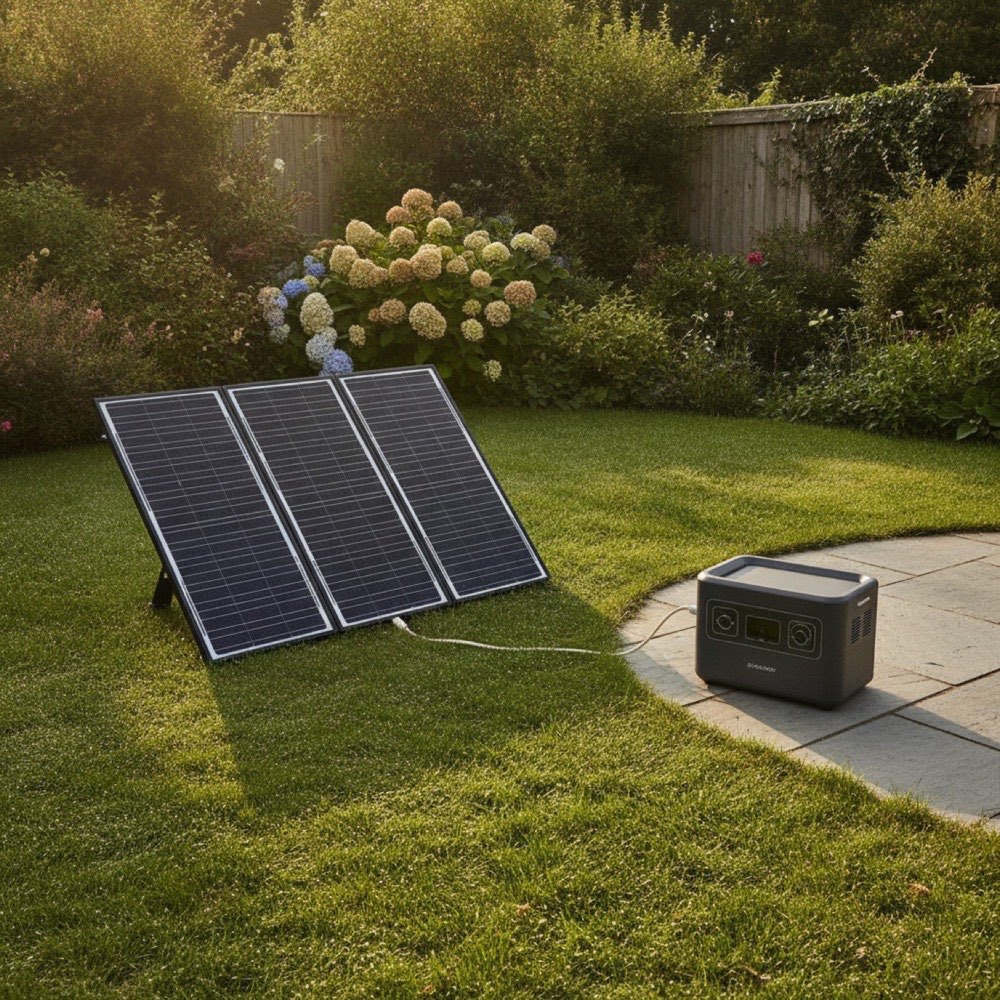
A solar generator is not one machine. It is a portable power station paired with a folding solar panel, and the pairing matters more than either half alone. The marketing around these bundles leans heavily on sunny-day numbers that rarely survive contact with a British sky, so this guide does something different: every specification below is taken from the manufacturer's own published figures, every pick is sold on amazon.co.uk right now, and the section on UK winter performance tells you plainly what a panel will and will not deliver in December. If you want the station side of the equation covered in more depth, our guide to the [best portable power stations](/best-portable-power-stations-uk/) is the companion piece to this one.
| Pick | Model | Why | |
|---|---|---|---|
| Best Overall Bundle | EcoFlow DELTA 3 Plus with 220W Bifacial Solar Panel | The strongest balance of capacity, solar input headroom and panel quality in one box. The bifacial panel gathers reflected light on its rear face, which genuinely helps in flat British light, and MC4 connectors keep your options open later. | Check price |
| Best Value Bundle | Jackery Solar Generator 1000 v2 (Explorer 1000 v2 + SolarSaga 100W) | The most sensible entry point into solar charging. The station is a proven, big-selling unit with a 1kWh-class battery, and the 100W panel is light enough at around 3.6kg to actually get used rather than left in a cupboard. | Check price |
| Best High Capacity Bundle | Bluetti Elite 200 V2 with 200W Solar Panel | Two kilowatt hours of storage with a 1,000W solar input ceiling, which is the figure that matters for serious off-grid or multi-day power cut use. You can add panels over the years and the station will keep absorbing them. | Check price |
| Best Panel Only | Anker SOLIX PS200 200W Portable Solar Panel | If you already own a power station, a well-made 200W folding panel is the single best upgrade you can buy for it, and the PS200's kickstand angles matter more in Britain than anywhere sunny: the 50 and 80 degree settings suit our low winter sun. | Check price |
| Best for Fast Solar Charging | Anker SOLIX C1000 Gen 2 with 200W Solar Panel | The highest solar input ceiling in the 1kWh class here: 600W of panels will refill this station in under two hours of genuine sun by Anker's figures, which turns a bright UK summer day into two or three full recharges. | Check price |
How we chose
This is a specification comparison, not a hands-on test, and we say so plainly. Every pick had to clear four gates. First, current availability on amazon.co.uk, checked at the time of writing, because a recommendation you cannot act on is worthless. Second, a lithium iron phosphate (LiFePO4) battery in the station, since LFP chemistry is rated by these manufacturers at 3,000 to 6,000 charge cycles against roughly 500 to 800 for the older lithium-ion packs, and a solar setup you plan to cycle daily needs that endurance. Third, verified figures only: every wattage, capacity, efficiency and IP rating in this guide comes from the manufacturer's published specifications, with the source pages listed at the end. Where a manufacturer's claim is a marketing figure rather than a measured standard, we attribute it as a claim. Fourth, honest pairing. A bundle only made the list if the panel and station make sense together, or if we could tell you clearly where the mismatch lies, as with the Bluetti kit above.
What we deliberately ignored: sunny-day recharge times quoted at full panel output, which you will rarely see in Britain, and peak surge wattage figures, which matter far less than continuous output for the kettles, fridges and heaters people actually run.
How a solar generator actually works
Strip away the branding and a solar generator is two components doing simple jobs. The folding solar panel converts light into DC electricity, typically at 18 to 21 volts for a portable panel. The power station takes that variable, weather-dependent input through an MPPT charge controller (maximum power point tracking, a circuit that continuously adjusts the electrical load on the panel to extract the most power the light allows), stores it in a battery, and serves it back out through mains sockets and USB ports via an inverter.
There is no magic in the word generator. Nothing is generated beyond what falls on the panel. A 200W panel in perfect laboratory conditions produces 200 watt hours per hour; in the real world it produces whatever the sky permits, which in Britain is usually a good deal less. This matters because the arithmetic is unforgiving. A 1,024Wh station like the DELTA 3 Plus holds roughly the energy needed to run a 60W fridge for a day and a half. Refilling that from sunlight is a function of panel wattage multiplied by hours of useful light multiplied by real-world losses, and each of those three numbers deserves scepticism.
Two specifications govern everything else when you compare bundles. The station's maximum solar input (400W on the Jackery 1000 v2, 500W on the DELTA 3 Plus, 600W on the Anker C1000 Gen 2, 1,000W on the Bluetti Elite 200 V2) sets the ceiling on how fast you can ever charge from the sun, no matter how many panels you buy. And the input voltage window (for example 11 to 60V on the EcoFlow, 12 to 60V on the Bluetti) determines which panels, and which combinations of panels wired in series, the station will accept at all. We come back to both in the compatibility section.
The UK winter reality: what a panel honestly delivers in December
This is the section most guides skip, and it is the one that decides whether a solar generator suits you. The European Commission's PVGIS database, the standard reference for solar resource across Europe, puts average daily solar energy in London at roughly 0.5 kWh per square metre in December against roughly 4.7 kWh per square metre in July. That is close to a ninefold gap. Expressed as equivalent peak sun hours, the figure UK installers work from, London sees around 0.6 hours per day in December and around 5 hours per day in July, with northern England and Scotland lower still in midwinter.
Run the sums on a 200W portable panel and the picture is stark. In July, five peak hours at 200W with typical real-world losses of 20 to 30 per cent (panel heat, imperfect angle, cable and MPPT losses) yields somewhere in the region of 700 to 800Wh on a good day: most of a 1kWh station from sunlight alone. In December, 0.6 peak hours through the same losses yields perhaps 80 to 120Wh on an average day, and on an overcast one, which is most of them, you may see a trickle of 20 to 40W flowing for a few hours around midday. That is enough to keep phones, lights and a router going. It is nowhere near enough to cycle a 1kWh battery, let alone the Bluetti's two.
Three honest conclusions follow. First, solar is a summer and shoulder-season recharge strategy in Britain, roughly March to October, and a top-up strategy in deep winter, not a primary one. Second, winter performance rewards angle and patience: the midwinter sun sits barely 12 to 15 degrees above the horizon at midday in southern England, so a panel propped steeply (this is where the PS200's 80 degree kickstand setting earns its place) facing due south catches usefully more than one laid at a gentle camping angle. A hard frost with clear sky is the best winter solar weather you will get, since panels are more efficient when cold. Third, anyone buying for power cut resilience should plan to keep the station topped up from the mains as standard practice, with solar as the means of extending endurance once a cut begins. Our guide on how to prepare for a power cut covers that routine in full.
None of this makes the panel pointless in winter. Multi-day cuts, the kind that follow storms, are precisely when 100Wh a day of silent, fuel-independent charging keeps communication and lighting alive after the battery would otherwise have run flat. It just makes the panel a different tool in January than it is in June, and you should buy knowing that.
The five picks in detail
Best Overall Bundle: EcoFlow DELTA 3 Plus with 220W Bifacial Solar Panel. EcoFlow's 1,024Wh station pairs a 1,800W inverter with a solar input of up to 500W across an 11 to 60V window, and the battery is rated at around 4,000 cycles to 80 per cent capacity, which at a cycle a day is a decade of use. The panel is the reason this bundle tops the list. Its TOPCon monocrystalline front face is rated at 220W with around 23 per cent conversion efficiency, and a 155W-rated rear face gathers light reflected from the ground, a genuine advantage in Britain's diffuse, overcast light where a surprising share of usable energy arrives indirectly. It carries an IP68 rating and standard MC4 connectors, so it will serve future stations too. The whole kit is car-boot portable rather than carry-on portable: the panel alone is around 9.5kg. For most households wanting one bundle that covers power cuts, camping and garden office use, this is the one. Check price on Amazon
Best Value Bundle: Jackery Solar Generator 1000 v2. The Explorer 1000 v2 station gives you 1,070Wh of LFP storage and a 1,500W inverter, and it accepts up to 400W of solar through two 8mm DC inputs (one working at 12 to 18V up to 8A, the other at 16 to 60V up to 10.5A). The bundled SolarSaga 100W panel is the lightest serious panel here at around 3.6kg, rated IP68, with Jackery claiming up to 25 per cent conversion efficiency. The honest caveat is pace: 100W of panel against 1,070Wh of battery means a full solar refill is a two-to-three-day affair even in decent British sun, so treat the panel as an extender rather than a fast charger, or add a second. The other caveat is Jackery's own-brand 8mm connectors, which make mixing in third-party MC4 panels an adapter-and-homework exercise. As a first solar generator at a mid three figures outlay, it is very hard to argue with. Check price on Amazon
Best High Capacity Bundle: Bluetti Elite 200 V2 with 200W Panel. The numbers that set this apart: 2,073.6Wh of storage, a 2,600W inverter, a battery rated at over 6,000 cycles, and crucially a 1,000W solar input ceiling across a 12 to 60V, 20A window. That last figure means this station can eventually drink from four or five 200W panels at once, refilling 2kWh in a summer afternoon. The bundled 200W folding panel (Bluetti publishes 23.4 per cent efficiency, IP65 weather resistance, MC4 connectors and a 26.1V open circuit voltage for its PV200) is a sound unit, but one panel against two kilowatt hours is deliberately undersized, and Bluetti's own quoted figure of around 13.5 hours of strong sun for a full charge from it confirms as much. Buy this bundle as the foundation of a system you will grow, or for households where the priority is a deep reserve for long cuts with solar as a useful extender. Check price on Amazon
Best Panel Only: Anker SOLIX PS200. For the many readers who already own a station from our best portable power stations guide, the smarter spend is a quality panel. The PS200 is a 200W folder with an IP67 rating and, unusually and usefully for Britain, a kickstand with set angles at 30, 40, 50 and 80 degrees. Those steeper settings are not a gimmick here: with the winter sun barely 15 degrees above the horizon, a panel standing near-vertical and facing south collects meaningfully more than one lounging at a summer angle. Anker's listing quotes up to 23 per cent energy conversion. One piece of homework before you order: confirm the supplied cable's connector matches your station's solar input, since the PS200 pairs most straightforwardly with Anker's own XT60-equipped stations. Check price on Amazon
Best for Fast Solar Charging: Anker SOLIX C1000 Gen 2 with 200W panel. On paper a familiar 1,024Wh, 2,000W LFP station, 11.3kg with a 5-year warranty. The distinguishing figure is the 600W solar input through its XT60 port, the highest ceiling in the 1kWh class in this guide. Feed it the full 600W and Anker quotes a solar recharge in around 1.8 hours, which in practical UK terms means a clear summer day can refill it more than once. The bundled 200W panel will not reach that pace alone, but the headroom is the point: this is the 1kWh station to buy if you intend to add panels and make solar your main charging route from spring to autumn. Amazon.co.uk lists it with 100W, 200W and 400W panel options. Check price on Amazon
Matching panels to stations: connectors, voltage and the compatibility trap
The question we are asked most often is some version of: can I plug this panel into that station? Three checks answer it every time.
Connector. MC4 is the industry-standard solar connector, a chunky weatherproof push-fit pair, and it is what you want on any panel you hope to keep through your next station. The EcoFlow 220W bifacial and Bluetti's 200W panel both use MC4. Stations vary on the receiving end: EcoFlow and Anker commonly use XT60 inputs (a yellow two-pin connector borrowed from the radio-control world) with an MC4-to-XT60 lead supplied or cheaply bought, while Jackery runs its own 8mm DC barrel connectors on both its panels and stations. Own-brand connectors are not a flaw within the brand's ecosystem, but they are a quiet tax on switching later.
Voltage window. Every station publishes an acceptable solar input voltage range: 11 to 60V on the DELTA 3 Plus, 12 to 60V on the Elite 200 V2, 12 to 18V or 16 to 60V depending on port for the Jackery. Your panel's open circuit voltage (Voc, the voltage it produces with nothing connected, always higher than its working voltage) must sit inside that window. A single portable panel almost always does: Bluetti's 200W panel has a Voc of 26.1V, the EcoFlow 220W is 21.8V. The trap arrives when you chain two panels in series to charge faster, which adds their voltages together. Two of those Bluetti panels in series present 52.2V, still inside a 60V window; three would exceed it and can damage the input. Wiring in parallel instead keeps voltage flat and adds current, but then the station's amp limit (20A on the Bluetti, for instance) becomes the constraint. Read both numbers before you expand.
Wattage ceiling. You can connect more panel wattage than the station's maximum input and the MPPT will simply cap the intake, which is actually sound practice in Britain: a 300W array feeding a 400W-limited port will rarely hit the cap under our skies but will raise the floor on dull days. What you cannot do is exceed the voltage or current limits, which are hard electrical boundaries rather than polite suggestions.
Setup and care
Getting the most from a panel in Britain is mostly about aim and housekeeping. Face it due south if you can, and adjust the tilt with the season: shallow in summer when the sun rides high, steep in winter when it skims the horizon. Reposition it once or twice through the day if you are around; chasing the sun across the sky can add a worthwhile margin to the day's harvest. Keep the surface clean, since a film of dust or pollen quietly shaves output, and keep it cool where possible, because panel efficiency falls as temperature rises, which is why a crisp bright March day can outperform a hot August one watt for watt.
Mind the ratings in wet weather. IP68 panels like EcoFlow's and Jackery's tolerate rain properly; IP65 units like Bluetti's 200W panel handle splashes and showers but should not sit out through a storm, and no folding panel's junction box and connectors enjoy sitting in standing water. The stations themselves are not weatherproof unless explicitly rated, so run the cable to shelter and keep the station inside or under cover.
Battery care is simpler than folklore suggests. LFP packs are content stored anywhere between roughly 30 and 80 per cent charge, topped up every few months. Avoid charging below freezing (most stations here refuse to, as self-protection), and store the kit somewhere the battery is not baking or freezing. Pack the panel dry, since folding damp fabric panels away wet invites delamination over time. For the wider kit that should live alongside the station, from torches to a wind-up radio, see our emergency kit list.
Solar generator vs petrol generator: the fair comparison
Plenty of guides strawman this one in solar's favour. The honest version has petrol winning two categories outright. On raw sustained power, a mid-sized petrol inverter generator delivers 2kW or more continuously for as long as you keep fuelling it, through any weather, at 2am in January, and no battery-and-panel combination at this scale matches that endurance. And on winter dependability, petrol does not care that the sun sits at 14 degrees for seven hours a day.
Solar generators win the other five categories, and they matter more for most households. Noise: a petrol set typically runs at anything from the mid 50s to over 70 decibels depending on type and load, which strains neighbourly relations in a terrace at the best of times and advertises your position during an outage; a power station is silent. Safety: petrol generators produce carbon monoxide and must never run indoors, in a garage, or near open windows, a restriction that kills people every year who ignore it, while a battery station runs safely on the kitchen counter. Fuel logistics: petrol stales within months without stabiliser, and UK regulations limit how much you may store at home and in what containers, whereas sunlight requires no storage, rotation or licence. Running cost: once bought, solar charging costs nothing per kWh and mains pre-charging costs pence, against petrol consumption of roughly a litre or more per hour under load. Maintenance: engines need oil, spark plugs and regular running; a power station needs a top-up charge a few times a year.
The honest verdict: for the typical UK household facing occasional cuts measured in hours or a day or two, the solar generator is the better tool, quieter, safer, and usable indoors where the need actually is. For rural properties with multi-day winter outages and heavy loads such as heating pumps or well pumps, petrol (or both, with the battery handling the night shift and electronics while the engine handles the heavy lifting in bursts) remains a rational choice. Fuel-burning kit and backup batteries both feature, in their proper places, in our guide to preparing for a power cut.
The picks in detail
Best Overall Bundle: EcoFlow DELTA 3 Plus with 220W Bifacial Solar Panel
1,024Wh LiFePO4 station, 1,800W AC output, solar input up to 500W (11 to 60V), around 4,000 charge cycles to 80 per cent; 220W bifacial panel (155W rear face), IP68, MC4 connectors, TOPCon monocrystalline cells at around 23 per cent efficiency
The strongest balance of capacity, solar input headroom and panel quality in one box. The bifacial panel gathers reflected light on its rear face, which genuinely helps in flat British light, and MC4 connectors keep your options open later.
Worth knowing: The panel alone weighs around 9.5kg, so this is a car-boot bundle rather than a rucksack one. The 500W solar ceiling is generous for one panel but caps future expansion sooner than the Bluetti below.
Best Value Bundle: Jackery Solar Generator 1000 v2 (Explorer 1000 v2 + SolarSaga 100W)
1,070Wh LiFePO4 station, 1,500W AC output, solar input up to 400W via two 8mm DC ports (12 to 18V at 8A, or 16 to 60V at 10.5A); SolarSaga 100W panel, up to 25 per cent conversion efficiency, IP68
The most sensible entry point into solar charging. The station is a proven, big-selling unit with a 1kWh-class battery, and the 100W panel is light enough at around 3.6kg to actually get used rather than left in a cupboard.
Worth knowing: A single 100W panel is a slow charger for a 1,070Wh battery, realistically a multi-day refill in UK conditions outside high summer. Jackery uses its own 8mm DC connectors rather than MC4, so third-party panel choices need an adapter and more care.
Best High Capacity Bundle: Bluetti Elite 200 V2 with 200W Solar Panel
2,073.6Wh LiFePO4 station, 2,600W AC output, solar input up to 1,000W (12 to 60V, 20A), 6,000+ charge cycles; bundled 200W folding panel (Bluetti lists its PV200 at 23.4 per cent efficiency, IP65, MC4, 26.1V open circuit)
Two kilowatt hours of storage with a 1,000W solar input ceiling, which is the figure that matters for serious off-grid or multi-day power cut use. You can add panels over the years and the station will keep absorbing them.
Worth knowing: One 200W panel against a 2kWh battery is a mismatch by design: Bluetti's own listing quotes around 13.5 hours of strong sun for a full refill from the single panel. Treat this bundle as a starting kit and budget for a second panel if solar is your main charging route.
Best Panel Only: Anker SOLIX PS200 200W Portable Solar Panel
200W rated output, IP67 rated, adjustable kickstand with set angles at 30, 40, 50 and 80 degrees, Anker quotes up to 23 per cent energy conversion on the listing
If you already own a power station, a well-made 200W folding panel is the single best upgrade you can buy for it, and the PS200's kickstand angles matter more in Britain than anywhere sunny: the 50 and 80 degree settings suit our low winter sun.
Worth knowing: Check the supplied cable's connector against your station's solar input before ordering; it pairs most straightforwardly with Anker's own stations. At 200W it needs a station that accepts at least that much solar input to earn its keep.
Best for Fast Solar Charging: Anker SOLIX C1000 Gen 2 with 200W Solar Panel
1,024Wh LiFePO4 station, 2,000W AC output, solar input up to 600W via XT60, around 4,000 cycles to 80 per cent, 11.3kg, 5-year warranty; sold on amazon.co.uk with 100W, 200W or 400W panel options
The highest solar input ceiling in the 1kWh class here: 600W of panels will refill this station in under two hours of genuine sun by Anker's figures, which turns a bright UK summer day into two or three full recharges.
Worth knowing: The 600W ceiling only pays off if you eventually buy more panel than the bundled 200W. The XT60 solar input is common but not universal, so note it if you plan to mix brands.
Your questions, answered
What is the best solar generator in the UK?
On verified specifications and current amazon.co.uk availability, the EcoFlow DELTA 3 Plus with the 220W bifacial panel is the strongest all-round bundle: a 1,024Wh LFP station with 1,800W output, paired with an IP68 MC4 panel whose rear face collects reflected light, a real advantage under Britain's diffuse skies. Buyers wanting a deeper reserve should look at the 2,073.6Wh Bluetti Elite 200 V2 bundle instead.
How many solar panels do I need to charge a power station in the UK?
Work from equivalent peak sun hours: roughly 5 per day in a London July and roughly 0.6 in December, per PVGIS data. To refill a 1,000Wh station in one summer day, 200 to 300W of panel is about right once you allow 20 to 30 per cent real-world losses. In winter, no realistic portable array fully recharges a 1kWh station in a day; even 400W of panel might gather 150 to 250Wh on an average December day. Buy panel wattage for the shoulder seasons and treat midwinter solar as a top-up.
Do solar generators work in UK winter?
The station works exactly as well in winter, but the solar side drops sharply: London receives roughly nine times more solar energy per day in July than in December. Expect a 200W panel to gather perhaps 80 to 120Wh on an average December day, enough for phones, lights and a router, not enough to cycle a large battery. Angling the panel steeply toward the low southern sun helps, and cold clear days are the best winter solar weather. Keep the station mains-charged as routine and use the panel to extend endurance during a cut.
Can I use any solar panel with any power station?
Often, but check three things first: the connector (MC4 is the open standard; Jackery uses its own 8mm plugs, many EcoFlow and Anker stations take XT60 with an MC4 adapter lead), the station's solar input voltage window against the panel's open circuit voltage, and the station's maximum input wattage and current. Panels chained in series add voltage, so two panels that each fit the window can exceed it together.
Is a solar generator better than a petrol generator?
For most UK households, yes: a solar generator is silent, produces no carbon monoxide so it can run indoors where the need is, requires no fuel storage, and costs almost nothing to run. Petrol wins on sustained output and winter dependability, which keeps it relevant for rural homes facing multi-day outages with heavy loads. Many well-prepared households eventually run one of each.
How long does a solar generator battery last?
Every pick in this guide uses lithium iron phosphate (LiFePO4) cells. Manufacturer cycle ratings run from around 4,000 cycles to 80 per cent remaining capacity (EcoFlow, Anker) to over 6,000 (Bluetti), which at a full cycle a day is 10 to 17 years before the battery fades to four fifths of its original capacity. Occasional users will realistically retire the electronics before the chemistry.
Can I leave a portable solar panel out in the rain?
Check the panel's own IP rating, not the bundle's headline. IP68-rated panels such as EcoFlow's 220W bifacial and Jackery's SolarSaga 100W tolerate sustained wet weather; IP65 panels such as Bluetti's 200W resist splashes and showers but should come in before a storm. Connectors and the station itself should always stay dry, and fold fabric panels away only once dry.
Should I buy a bundle or the panel and station separately?
Bundles usually price below the two parts bought separately and guarantee the connectors match, which makes them the sensible default for a first purchase. Buy separately when you already own a station, when you want more panel wattage than the standard bundle offers, or when you specifically want MC4 panels for cross-brand flexibility later.