Emergency Water for UK Homes: Filtration and Storage Guide
Last updated: 21 October 2026
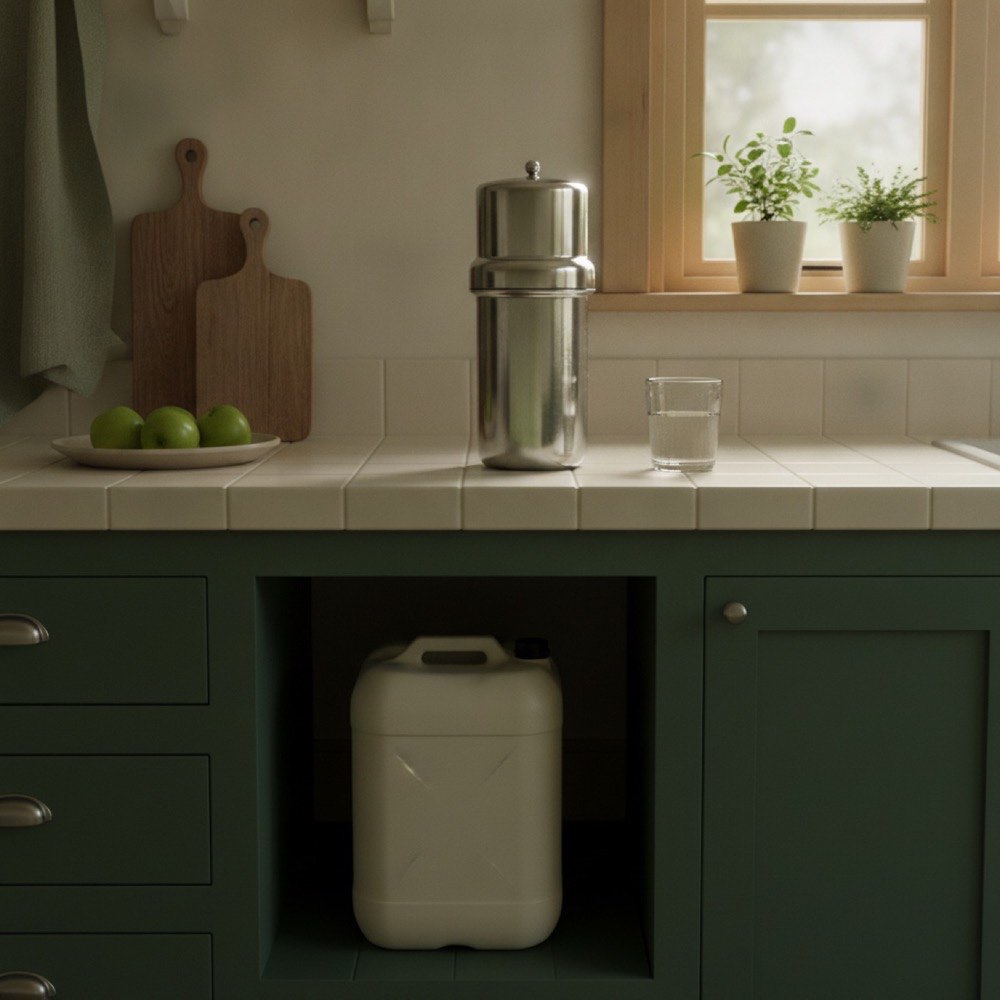
Most British households have never gone more than a few hours without running water, which is precisely why so few of us keep any in reserve. Yet every winter, somewhere in the UK, a freeze followed by a rapid thaw bursts hundreds of mains and leaves whole towns queueing at bottled water stations. The fix is neither expensive nor complicated: a modest store of water, a means of making more water safe, and ten minutes spent understanding what your water company owes you when the taps run dry. This guide covers all three, with every safety figure drawn from WHO, NHS and Ofwat guidance rather than folklore.
How mains water actually fails in the UK
Supply interruptions in this country are rarely dramatic. They fall into three familiar patterns, and understanding them tells you what to prepare for.
Burst mains. The most common cause. A single large main can serve tens of thousands of properties, and when one fails the pressure drop can empty taps across a wide area for anything from a few hours to a few days while crews excavate and repair.
Freeze-thaw events. The serious ones. When a hard freeze is followed by a rapid rise in temperature, pipes that contracted in the cold expand quickly and fail in large numbers at once. In December 2022, South East Water recorded 316 burst main repairs in a single week against 96 in the same period the year before, and repaired 473 leaks in total, more than three times its seasonal average, while daily demand jumped from 570 to 620 million litres as water escaped through fractured pipes. Thousands of homes across Kent and Sussex were without water over Christmas. South West Water reported a temperature swing of 12.1 degrees in 48 hours during the same event, sharper than the 2018 Beast from the East. These incidents are documented in the companies' formal reports to Ofwat, and they recur in some form most winters. If you have read our guide to preparing for a power cut, the same cold snaps tend to drive both problems at once.
Contamination notices. Sometimes the water keeps flowing but is not safe to drink as it comes. UK water companies issue two distinct kinds of notice, and the difference matters. A boil water notice means microbiological contamination is suspected and boiling makes the water safe. A do not drink or do not use notice means chemical contamination, and no amount of boiling or filtering makes that water safe. Always read which notice you have been given, because the correct response is completely different.
None of this is cause for alarm. UK tap water remains among the most closely monitored in the world. But interruptions are a normal feature of an ageing network under climate stress, and a household that has planned for three days without taps rides them out with no drama at all.
What your water company must do when the taps stop
You are not on your own when supply fails, and it is worth knowing exactly what the rules say before you decide how much to store yourself.
Under the arrangements Ofwat oversees, if the piped supply fails, your water company must provide an alternative supply of at least 10 litres per person per day, starting within the first 24 hours, and keep providing it until the piped supply is restored. In practice that means bottled water stations, bowsers (towable tanks parked on street corners) or standpipes. Companies must also tell you that the supply is interrupted, where to collect water, when they expect restoration, and how to reach them. Where companies miss guaranteed standards of service there are fixed compensation payments under the Guaranteed Standards Scheme.
Two practical caveats stop this being a complete answer:
- The first 24 hours are yours to cover. The duty bites within a day of the failure. During the 2022 freeze-thaw, many households found the early hours of an incident were the chaotic part, before stations were set up and stocked.
- It is collection, not delivery. For most customers the obligation is met by making water available somewhere you must travel to, queue for and carry home. Ten litres of water weighs ten kilograms. If that journey would be difficult for you, read on.
The Priority Services Register. Every UK water company runs one, it costs nothing to join, and it exists precisely for people who cannot stand in a car park with jerry cans: older people, disabled people, people with medical conditions, those dependent on water for medical devices, and families with very young children. Registered customers get priority treatment during interruptions, including bottled water brought to the door rather than collected, plus advance notice of planned works. If anyone in your home qualifies, registering takes five minutes on your water company's website and is the single highest-value preparedness action in this entire guide. A note on bowsers: treat the water from them as drinking water only after following the instructions printed on the tank, which commonly advise boiling first as a precaution.
How much water to store per person
The figures here are verified against WHO technical guidance and the UK government's own Prepare campaign, because this is the question where internet folklore does the most damage.
Survival minimum: 2.5 to 3 litres of drinking water per person per day. This is the World Health Organization's figure for drinking and the water content of food, and it is the number the government's Prepare campaign quotes directly.
Comfortable minimum: 10 litres per person per day. The Prepare campaign recommends this level because it also covers basic cooking and hygiene, and it conveniently matches the 10 litres your water company must provide. WHO's technical note on emergencies puts basic needs at 7.5 to 15 litres per person per day, so 10 sits sensibly in the middle.
Plan for three days as a baseline. Most UK interruptions resolve within hours; the bad ones run to a few days. Three days of stored water bridges you to either restoration or a functioning bottled water station.
Worked example for a household of four:
- Bare survival: 3 litres x 4 people x 3 days = 36 litres. That is six standard 6-packs of 2-litre bottles, one supermarket trip.
- Comfortable: 10 litres x 4 people x 3 days = 120 litres. Realistic only with dedicated containers, which is where 25-litre jerry cans earn their place.
A sensible UK household target is the full 36 litres of sealed drinking water plus two or three large containers you can fill when an incident looks likely, for instance when a hard freeze is forecast to break. Add extra for anyone preparing infant formula, anyone using water-dependent medical equipment, and pets. Dogs and cats need roughly 50 to 60 millilitres per kilogram of body weight per day, so a spare few litres covers most animals.
Storing water properly at home
Water storage fails in boring ways: tainted containers, forgotten rotation, and 25 kilograms of water stored somewhere nobody can lift it from. All three are easy to avoid.
Sealed bottled water is the foundation. The Prepare campaign recommends bought bottled water as the core store for good reason: it is sealed in food-contact packaging, marked with a best-before date, and needs no treatment. Keep it out of sunlight, away from strong-smelling chemicals (plastic bottles are slightly permeable to vapours, so not next to the white spirit in the garage), and rotate it through normal use before the date on the pack.
Containers for bulk water. For the step up to 10 litres per person per day, use purpose-made containers that are food grade, ideally UN-approved HDPE jerry cans in the 10 to 25 litre range with a tap. A 25-litre food grade container with a tap is the standard unit: stackable, sturdy and sized so that one can covers one person for two to three comfortable days. Never reuse milk bottles or juice containers, which harbour bacteria in their seams, and never store drinking water in anything that has held chemicals, however well rinsed.
Filling and rotation. UK tap water is chlorinated and stores well in a clean sealed container. Wash the container with hot soapy water, rinse thoroughly, fill from the cold kitchen tap, cap tightly, label with the date, and refresh every few months by watering the garden with the old fill. Keep containers cool, dark and off bare concrete floors.
Where to keep it. Split the store. A slab of bottled water under a bed, jerry cans in a cupboard or garage, a couple of litres in the car. Remember the weight: a full 25-litre can weighs 25 kilograms, so store large cans low and consider 10 or 15 litre cans if anyone in the house would struggle. Your hot water cylinder, if you have one, holds a useful hidden reserve for flushing and washing during an outage, though water that has sat in a cylinder should be boiled before anyone drinks it.
Water is one pillar of a wider plan; the full emergency kit list and our guide to building an emergency food supply cover the rest.
Making water safe: boiling comes first
Before any gadget, learn the one method that works with equipment you already own. Boiling is the reference standard for microbiological treatment: it kills bacteria, viruses and protozoa including Cryptosporidium, which some chemical treatments cannot touch.
The method: bring water to a full rolling boil, hold it there for one minute, then let it cool in a covered, clean container. The one-minute rolling boil is the figure used in WHO and CDC household guidance and comfortably exceeds what is needed at UK altitudes. During a UK boil water notice, follow the specific instructions your water company issues; they define what the water may be used for and when the notice is lifted.
Points worth knowing:
- Boiled water tastes flat. Pouring it between two clean containers a few times puts air back in.
- Under a typical boil notice, unboiled tap water generally remains usable for toilet flushing, laundry and bathing (keeping it out of mouths, with care around small children). Again, your company's notice governs.
- Boiling removes microorganisms only. It does not remove chemical contamination, and on a do-not-drink notice boiling achieves nothing.
- If mains gas and electricity are also down, a camping stove boils water as well as a kettle does, which is one more argument for the stove in your emergency kit.
Purification tablets: the lightweight backup
Chlorine-based purification tablets are the cheapest insurance in this entire category, which is why they belong in every kit even though they never appear in a product roundup. Aquatabs are the familiar name: each tablet contains NaDCC (sodium dichloroisocyanurate), which dissolves to release a measured dose of chlorine disinfectant, the same chemistry used in humanitarian response worldwide.
What they handle: bacteria, viruses and Giardia, in clear water, with a contact time of around 30 minutes per the pack instructions.
What they do not handle: the manufacturer is explicit that Aquatabs are not proven effective against Cryptosporidium, whose tough outer shell resists chlorine disinfection. Where Cryptosporidium is a possibility, the manufacturer's own advice is to filter the water to 1 micron absolute or finer before treating, or simply to boil instead. Tablets also do nothing about chemical contamination, and they work poorly in cloudy water, which should be allowed to settle and then poured through clean cloth before treatment.
The practical role of tablets in a UK household plan is as the backup to the backup: feather-light, long-dated, and the thing you are glad of if an incident outlasts your ability to boil. A single tub treats more water than most households would use in weeks.
Gravity filters: the household workhorse
If storage covers the first three days, a gravity filter covers the awkward scenario beyond it: a longer interruption where you are collecting water from bowsers, neighbours' butts or other imperfect sources and want a reliable way to make large volumes trustworthy without standing over a kettle all day.
A gravity filter is two stacked chambers, usually stainless steel, with ceramic or composite filter elements between them. You pour water in the top; clean water collects in the bottom. No power, no plumbing, no moving parts, which is exactly the profile you want in an emergency.
British Berkefeld and Doulton are the UK-appropriate choice, not out of sentiment but because the ceramic candle technology is British, made by Doulton in Staffordshire, and replacement elements are easy to obtain here. The British Berkefeld 8.5-litre system with Ultra Sterasyl elements is the standard household size. The manufacturer's published performance for the ceramic elements: greater than 99.99 percent reduction of pathogenic bacteria (including E. coli, cholera and typhoid organisms) and greater than 99.99 percent reduction of cysts including Cryptosporidium and Giardia, via a 0.2 micron pore structure. That Cryptosporidium performance is the significant one, since it is the gap chlorine tablets leave. The Ultra Sterasyl element adds an activated carbon core that the maker states reduces chemicals such as chlorine, herbicides, pesticides and VOCs. Elements are cleanable: when flow slows, you scrub the ceramic surface under running water and carry on, with each candle good for a long service life before replacement. Keeping a set of spare Ultra Sterasyl candles in the cupboard makes the system effectively indefinite.
ProOne is the other serious name in gravity filtration. Its G2.0 elements carry NSF/ANSI component certification and are independently tested for reduction of lead, microplastics and PFAS, and they fit the ProOne housings as well as most other gravity housings of the same format, which makes them a credible upgrade path.
In normal times the same unit sits on the worktop improving everyday drinking water, so it is not a purchase that waits in a cupboard for a disaster that may never come. It is the most expensive item on this page, firmly in three-figure territory, and the one that most changes what a long interruption feels like.
Portable filters for one person on the move
Gravity systems serve a household; portable filters serve a person. They earn a place in a grab bag, a car kit or a commuter's rucksack.
LifeStraw. The original LifeStraw is a straw-style hollow-fibre membrane filter: you drink directly through it from a bottle, pan or stream. The manufacturer states it removes bacteria, parasites and microplastics through a 0.2 micron membrane. It filters on demand with no stored clean water, which makes it a pure emergency tool. For a household-scale version of the same membrane technology, the LifeStraw Peak gravity system hangs from a door handle and filters into any container below.
Sawyer. The Sawyer Squeeze uses a 0.1 micron hollow-fibre membrane, screws onto standard soft pouches and many drinks bottles, and can be backflushed to restore flow almost indefinitely, which is why it is the long-distance walker's default. It removes bacteria and protozoa to the manufacturer's stated standard.
The shared limitation: neither LifeStraw nor Sawyer membranes remove viruses, which at 0.02 microns and smaller pass through both. In UK-sourced fresh water the practical viral risk is low, but where sewage contamination is suspected, for instance floodwater or a main burst near foul drainage, pair the filter with boiling or chlorine tablets rather than trusting it alone. Membrane filters must also be protected from freezing once wetted, as ice damages the fibres invisibly, so do not leave a used one in the car through winter.
What filters do not remove
This is where marketing gets loose and this page will not. Precision matters, so here is the honest capability map, drawn from the manufacturers' own statements.
- Viruses. Doulton states plainly that its ceramic elements do not filter viruses. LifeStraw and Sawyer membrane filters do not remove them either. Viruses are smaller than any of these pore sizes. Boiling and chlorine tablets both deal with them; filters alone do not.
- Dissolved salts and minerals. No gravity or membrane filter here desalinates or removes dissolved mineral salts. Doulton markets this as a feature for everyday use, since healthy minerals pass through, but it means no filter on this page makes seawater drinkable.
- Chemical contamination. Plain ceramic and membrane filters remove essentially no dissolved chemicals. Carbon stages (the Ultra Sterasyl core, ProOne's elements) reduce specific listed chemicals, with ProOne's G2.0 independently certified for lead, microplastics and PFAS reduction. But "reduces listed chemicals in drinking-quality water" is a different claim from "makes chemically contaminated water safe", and no household device supports the second claim. On a do-not-drink notice, use stored or supplied water only.
- Heavy metals. Not removed by straw or squeeze filters at all. Only filters with certified media, such as ProOne's lead claim, reduce specific metals, and only to the tested standard.
- Cryptosporidium, the reverse case. Here filters beat chemistry: quality ceramic and membrane filters physically strain Cryptosporidium out, while chlorine tablets are not proven against it. This is why a layered approach, filter plus boil or filter plus tablets, covers everything a single method misses.
One rule distils all of this: filters handle organisms, boiling handles organisms, chlorine handles most organisms, and nothing in your kitchen handles chemicals. Match the tool to the problem named in the notice.
Babies, formula and households that need extra help
Infant formula is the highest-stakes water use in any home, and NHS guidance is specific, so it is worth stating exactly.
Making up formula in normal times: the NHS says water must be at least 70 degrees Celsius when it meets the powder, because formula powder is not sterile and the heat kills any bacteria within it. In practice: boil at least a litre in the kettle and use it within 30 minutes (within 15 minutes for 500 millilitres), then cool the made-up feed to body temperature.
Using bottled water for formula: permitted by the NHS with two conditions. First, check the label: sodium (Na) must be no more than 200 milligrams per litre and sulphate (SO4) no more than 250 milligrams per litre, which rules out some natural mineral waters. Second, and widely missed: bottled water is not sterile and must still be boiled before making up a feed, exactly as tap water would be. Stock your stored water with the label figures in mind if there is a baby in the house, and store more than the adult allowance, since feed preparation, sterilising and washing up consume several extra litres a day.
Filtered water and formula: a gravity filter does not change the rule. Water for feeds gets boiled to at least 70 degrees regardless of what it has passed through.
And repeat the single best action: any household with a baby, an older person, a disability or medical dependence on water should be on their water company's Priority Services Register today, while the taps work. That is what converts "queue at a car park" into "bottled water at the door" when the next freeze-thaw arrives.
Your water plan in one afternoon
Everything above compresses into five actions, in order of value:
- Register anyone eligible on your water company's Priority Services Register. Cost: nothing. Time: five minutes.
- Buy the baseline store: 3 litres per person per day for three days in sealed bottled water, slid under a bed. For four people that is one supermarket trip.
- Add bulk capacity: two or three food grade 25-litre containers with taps, plus the habit of filling them when a hard freeze is forecast to break.
- Add treatment in layers: a tub of purification tablets in the kit for pennies, and when budget allows, a British Berkefeld or equivalent gravity system that improves your water every ordinary day and carries you through any extraordinary one.
- Write down your water company's incident line and the location it historically uses for bottled water stations, and put it with your emergency kit.
Water sits alongside warmth and food as one of the three pillars of home readiness. If you have not yet covered the other two, start with preparing for a power cut and building a sensible food store. None of it is about fear. It is about making the next burst main someone else's bad week.
The kit that earns its place
British Berkefeld 8.5L Stainless Steel Gravity Filter System (Ultra Sterasyl)
The household workhorse: no power or plumbing, Doulton-made 0.2 micron ceramic elements with a stated 99.99 percent plus reduction of bacteria and cysts including Cryptosporidium, plus a carbon core for chemical reduction. Useful every day, decisive in a long interruption. (premium, £200 plus)
British Berkefeld 8.5L Bundle (system with stainless tap and accessories)
The same 8.5-litre system packaged with upgraded tap and accessories, for buyers who want the complete worktop setup in one purchase rather than piecing it together. (premium, £200 plus)
British Berkefeld / Doulton Ultra Sterasyl Replacement Candles
Spare elements turn a gravity system into effectively indefinite capacity. Ceramic candles are cleanable and long-lived, and a boxed spare set means the system never waits on a delivery mid-incident. (£50 to £100 for a multi-candle set)
ProOne G2.0 9-Inch Gravity Replacement Filters (3-Pack)
NSF/ANSI component-certified elements independently tested for reduction of lead, microplastics and PFAS, compatible with ProOne Big+ housings and most other gravity systems of the same format. The strongest chemical-reduction claims in the gravity category. (£100 plus)
LifeStraw Peak Series Gravity Water Filter System
Hang-anywhere membrane filtration for a household on the move or a second home: 0.2 micron hollow-fibre removal of bacteria, parasites and microplastics per the manufacturer, filtering into any container with no pumping. (£50 to £100)
25L UN-Approved Food Grade Water Containers with Tap (Multi-Pack)
The standard bulk storage unit: stackable food contact HDPE, tap for controlled pouring, and one can covers one person for two to three comfortable days. Buying a multi-pack reaches the 10 litres per person per day standard for a family. (under £100 for a multi-pack)
Your questions, answered
How do you purify water in an emergency in the UK?
Boiling is the gold standard: bring water to a full rolling boil for one minute, then cool it covered. It kills bacteria, viruses and protozoa including Cryptosporidium. Chlorine-based tablets such as Aquatabs handle bacteria, viruses and Giardia but are not proven against Cryptosporidium. Quality ceramic or membrane filters remove bacteria and Cryptosporidium but not viruses. Layering two methods, for example filtering then boiling, covers every gap. Nothing in the home makes chemically contaminated water safe, so on a do-not-drink notice use stored or supplied water only.
How much water should I store per person in the UK?
The World Health Organization's survival figure, quoted by the UK government's Prepare campaign, is 2.5 to 3 litres of drinking water per person per day. The Prepare campaign recommends 10 litres per person per day for comfort, covering basic cooking and hygiene as well. Planning for three days is a sensible baseline, so a household of four needs 36 litres as a survival minimum and around 120 litres for comfort. Add extra for babies, medical needs and pets.
What must my water company provide if supply is cut off?
Under the standards Ofwat oversees, if the piped supply fails your company must provide an alternative supply of at least 10 litres per person per day within the first 24 hours, continuing until supply is restored, usually via bottled water stations, bowsers or standpipes. It must also tell you where to collect water and when restoration is expected. Customers on the Priority Services Register can receive bottled water delivered to the door instead of collecting it.
What is the best gravity water filter for UK homes?
The British Berkefeld stainless steel systems with Doulton-made Ultra Sterasyl ceramic elements are the established UK choice: the manufacturer states greater than 99.99 percent reduction of pathogenic bacteria and of cysts including Cryptosporidium and Giardia, with a carbon core that reduces chemicals such as chlorine, pesticides and VOCs. The 8.5-litre size suits most families. ProOne systems and elements are the main alternative, with NSF/ANSI certified reduction of lead, microplastics and PFAS. Neither removes viruses or dissolved salts.
Do water filters remove viruses?
The common household and portable filters do not. Doulton states its ceramic elements do not filter viruses, and the LifeStraw and Sawyer membranes (0.2 and 0.1 micron) cannot trap particles as small as viruses, which can be 0.02 microns. Viral risk in UK mains-derived water is low, but where sewage contamination is possible, boil the filtered water or treat it with chlorine tablets as a second step.
Can I use bottled water for baby formula during a supply interruption?
Yes, with two NHS conditions. Check the label: sodium (Na) no higher than 200 milligrams per litre and sulphate (SO4) no higher than 250 milligrams per litre, which excludes some natural mineral waters. And bottled water is not sterile, so it must still be boiled, with the water at a minimum of 70 degrees Celsius when it meets the powder, exactly as with tap water.
How long does stored water keep?
Sealed bottled water keeps until its best-before date and well beyond if stored cool, dark and away from chemical vapours; rotate it through normal use. Tap water in a clean, sealed, food grade container stores well thanks to its residual chlorine; a sensible habit is refreshing self-filled containers every few months and washing the container between fills. Boiled water for drinking should be kept covered in the fridge and used within about 24 hours.
Is water from a bowser safe to drink?
Treat bowser water with mild caution. Companies deploy bowsers as an emergency alternative supply, and the instructions printed on the tank commonly advise boiling the water before drinking or preparing food as a precaution, because the water has been through a mobile tank rather than the sealed mains. Follow whatever the label and your water company's incident updates say; boiling first costs nothing but a few minutes.