Best Portable Power Stations UK: 2026 Buyer's Guide
Last updated: 21 October 2026
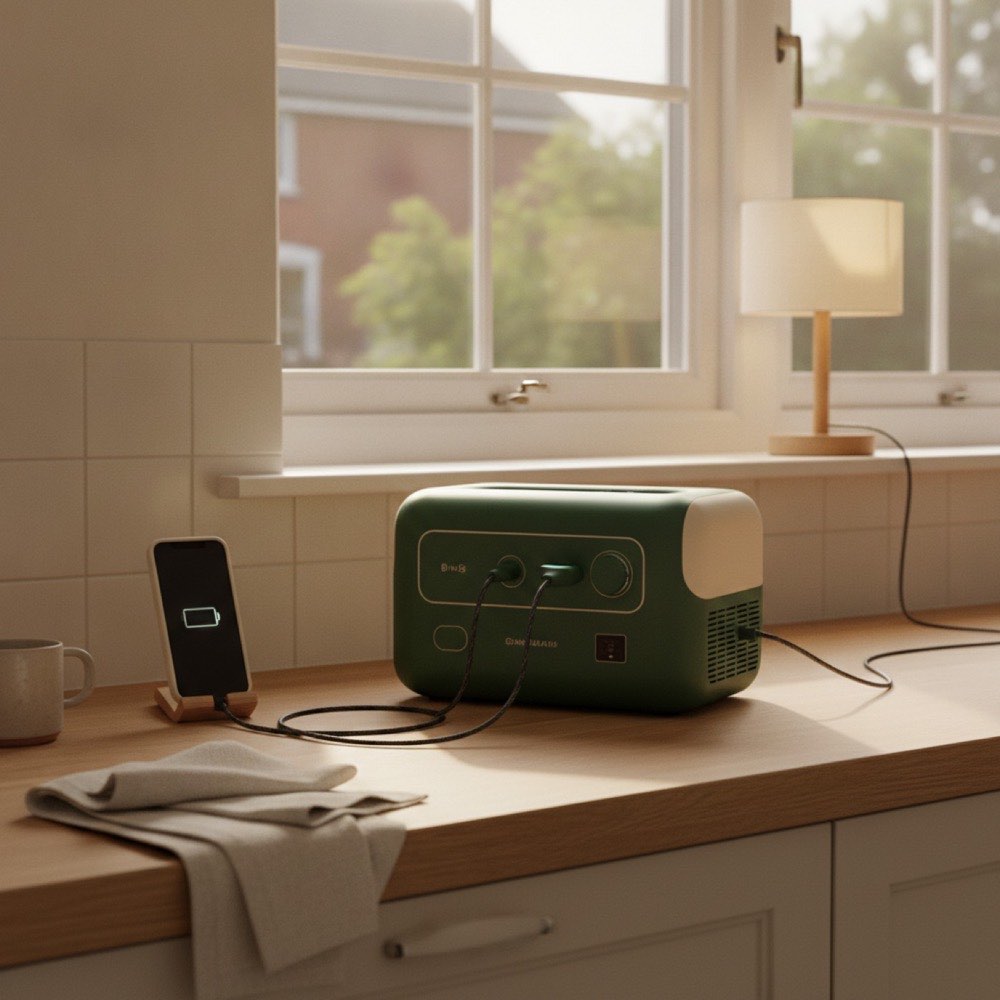
A portable power station is a big rechargeable battery with proper UK three pin sockets on the front, and during a power cut it is the difference between a normal evening and a cold, dark, disconnected one. The market is now crowded with models that look identical on a thumbnail but differ enormously in capacity, output, battery chemistry and charging speed. We compared the manufacturers' published specifications across the current UK ranges from EcoFlow, Jackery, Bluetti and Anker SOLIX, verified that every pick is actually sold on amazon.co.uk right now, and built a sizing method around what British household kit genuinely draws. Five picks made the cut. Before you look at any of them, work through the sizing section first: buying the wrong capacity is the single most common and most expensive mistake in this category.
| Pick | Model | Why | |
|---|---|---|---|
| Best Overall | EcoFlow DELTA 3 Plus | The DELTA 3 Plus hits the sweet spot for most UK households: 1024Wh of LiFePO4 capacity, 1800W of continuous AC output through four UK sockets, and a published UPS switchover under 10ms, the fastest of any pick here. EcoFlow's published charging figures are also the strongest in this group, with a full mains recharge in 56 minutes and dual MPPT solar ports accepting up to 1,000W of panels. | Check price |
| Best for Families | Jackery Explorer 1000 v2 | Jackery pitches the 1000 v2 as the smallest and lightest 1kWh LFP power station in its class, and at a listed 10.8kg it is genuinely manageable for one adult to carry upstairs or out to the car. The published spec sheet covers family essentials well: 1070Wh, 1500W continuous output with a 3000W surge, a UPS mode rated at 20ms or better and certified to IEC 62040, and whisper quiet operation under 22dB so it can sit in a bedroom overnight. | Check price |
| Best for Long Cuts | BLUETTI Elite 200 V2 | When a cut stretches past a few hours, capacity is everything, and the Elite 200 V2 carries 2073.6Wh, double the other large picks here. Its 2600W pure sine wave inverter is the most powerful in this guide and will run almost any single household appliance short of a kettle or electric heater. The published cycle life of 6,000 cycles to 80% is the best figure of any pick, and Bluetti quotes a 15ms UPS switchover plus up to 1,800W of mains input and 1,000W of solar input. | Check price |
| Best Compact | Anker SOLIX C300 | The C300 is the pick you actually carry: just over 4kg, 288Wh of LiFePO4 capacity, 300W of AC output with a 600W surge, and a port layout built around modern devices, including a 140W two way USB-C that recharges the unit itself or fast charges a laptop. Anker publishes an 80% mains recharge in around 50 minutes, and the built in light is genuinely useful rather than a gimmick when you are hunting for the fuse box. | Check price |
| Best Budget | EcoFlow RIVER 3 | The RIVER 3 is the honest entry point: 245Wh, 300W of AC output with X-Boost stretching to 600W for some appliances, LiFePO4 cells rated for 3,000 cycles, and a UPS switchover of 20ms or better, a feature that simply did not exist at this end of the market a few years ago. At a listed 3.55kg it is the lightest AC capable pick in this guide. | Check price |
How we chose these five
We have not run lab tests on these units, and we will not pretend otherwise. What we did instead was a structured comparison of the manufacturers' published specifications across the current UK ranges from EcoFlow, Jackery, Bluetti and Anker SOLIX, checked against each maker's own spec pages rather than retailer copy, with every figure in this guide traceable to a source listed at the bottom of the page. We then confirmed that each pick is listed and sold on amazon.co.uk at the time of writing, because a brilliant model you cannot actually buy in Britain is no use to anyone.
Four criteria did the sorting. First, battery chemistry: every pick uses lithium iron phosphate (LiFePO4) cells, for reasons the chemistry section below explains, and models still shipping older NMC packs were set aside. Second, published cycle life, because a power station is a ten year purchase if the cells last and a three year one if they do not. Third, UPS or switchover capability, since keeping a router or a CPAP machine running through the first moment of a cut is one of the main reasons UK buyers want these. Fourth, charging flexibility: mains speed, car charging, and how much solar input the unit will accept if you add panels later. Where a manufacturer's claim looked ambiguous, we either verified it against their own documentation or left it out of this guide entirely.
One more thing we deliberately did not do: chase the biggest numbers. The right power station is the one sized to your actual outage pattern, which is what the next section is for.
What size power station do you need? A UK sizing method that works
Capacity is measured in watt hours (Wh). A 1,000Wh unit can, in theory, run a 100W load for ten hours. In practice the inverter and electronics eat some of that, so a sensible rule is to treat usable capacity as about 85% of the rated figure. The method is simple: list what you need to keep running, find each item's real draw in watts, multiply by the hours you need, add it up, then divide by 0.85.
Here is what common UK household kit typically draws. Check the label or plug in energy monitor for your own devices, because these are typical figures, not promises:
- Broadband router and modem: 7 to 15W. Call it 12W.
- Phone recharge: roughly 15Wh per full charge.
- Laptop recharge: roughly 50 to 70Wh per full charge.
- LED lamp: 5 to 10W each.
- Television: roughly 50 to 100W depending on size and settings.
- CPAP machine: typically around 10W with the heated humidifier off, 30 to 60W with it on. Check your model's power supply label, it matters enormously here.
- Fridge freezer: the compressor cycles on and off, so ignore the peak figure on the label. A modern unit typically consumes 0.6 to 1kWh across a full day.
Worked example 1, the evening cut. A four hour evening outage, keeping the router up (12W x 4h = 48Wh), two phone charges (30Wh), two LED lamps (16W x 4h = 64Wh) and three hours of television (60W x 3h = 180Wh). Total: 322Wh. Divide by 0.85 and you need about 380Wh. A 245Wh unit like the RIVER 3 covers this scenario if you drop the television; a 1,000Wh class unit covers it without thinking.
Worked example 2, the overnight CPAP user. Eight hours at 10W with the humidifier off is just 80Wh, about 95Wh after losses, trivially within reach of even the smallest pick here. Eight hours at 40W with heated humidification is 320Wh, about 375Wh after losses, which pushes past the compact units. This single setting is the difference between a 288Wh unit lasting the night and failing at 3am, which is why we keep banging on about checking real draw.
Worked example 3, the fridge through a long cut. A fridge freezer consuming 0.9kWh per day needs roughly 1,060Wh of battery after losses to cover 24 hours, assuming you keep the door shut. A 1,000Wh class unit gets you most of the way through a day; the 2,073Wh Bluetti covers the full day with headroom for the router, lights and phones on top. For anything beyond 24 hours you are into solar panel territory, covered in our solar generators guide.
Size to your realistic worst case, then add 20% margin. Storm outages in rural Britain regularly run 12 to 48 hours; urban cuts are usually under four. Your postcode history matters more than any spec sheet, and our power cut preparation guide covers how to find it.
Best overall: EcoFlow DELTA 3 Plus
The DELTA 3 Plus is the pick we would point most UK households toward, because its published specification covers the widest spread of realistic scenarios without tipping into money you do not need to spend. The core numbers: 1024Wh of LiFePO4 capacity, 1800W of continuous AC output across four UK three pin sockets, eleven outlets in total including two USB-C ports, and cells rated for 4,000 cycles before dropping to 80% capacity, which at a cycle a day is over a decade of service.
Two published figures separate it from the field. The first is charging: EcoFlow quotes a 0 to 100% mains recharge in 56 minutes at up to 1500W input, which in storm warning terms means a flat unit becomes a full one between the forecast and the weather arriving. The second is the UPS switchover, published at under 10ms, the fastest here. Plug the unit into the wall, plug your router, desktop or CPAP into the unit, and when the grid drops the battery takes over quickly enough that most equipment never notices. For home workers in cut prone areas this one feature justifies the category.
Solar readiness is strong too: dual MPPT ports accept up to 1,000W of panels, so the upgrade path to genuine off grid recharging is already built in. Honest caveats: the 2400W X-Boost mode stretches to some resistive appliances but not a standard 3kW kettle, it is heavier than the Jackery, and if your outages are rare and short, the RIVER 3 below does the essentials for a fraction of the outlay.
Best for families: Jackery Explorer 1000 v2
Jackery's case for the family slot is about liveability rather than raw numbers. The Explorer 1000 v2 packs 1070Wh, slightly more than the EcoFlow, into what the company describes as the smallest and lightest 1kWh LFP power station in its class, with a listed weight of 10.8kg. That is the difference between a unit that gets fetched when needed and one that stays in the garage because nobody fancies lifting it.
The published specification holds up where families need it to: 1500W of continuous output with a 3000W surge handles the awkward start up spikes of fridges and microwaves, the LiFePO4 pack is rated for 4,000 cycles, and the UPS mode is quoted at 20ms or better and certified to IEC 62040, the international UPS standard, a certification most rivals do not bother obtaining. Jackery also publishes operating noise under 22dB, quiet enough for a child's bedroom overnight, and an emergency fast charge mode that fills the battery from the mains in as little as an hour.
The compromises are real but liveable. Two AC sockets is tight for a family, so budget for a short extension lead. Solar input is capped at 400W, enough for meaningful daytime recharging but well short of the EcoFlow's 1,000W ceiling, so buyers planning a serious panel setup should weigh that before choosing. As an all round family outage unit at its typical selling level, though, it is very hard to argue with.
Best for long cuts: BLUETTI Elite 200 V2
If your outages are measured in days rather than hours, storm country in Scotland, rural Wales, the fens, capacity stops being a nice to have and becomes the entire purchase decision. The Elite 200 V2 carries 2073.6Wh, double the two 1kWh picks above, and pairs it with a 2600W pure sine wave inverter, the most powerful output stage in this guide. In practical terms that is a fridge freezer, router, lights, phones and a laptop through a full 24 hour cut, with capacity left over.
The longevity figures are the best we found anywhere in the current UK market: Bluetti rates the LiFePO4 pack at 6,000 cycles to 80% capacity and talks in terms of a 17 year design life. The unit also accepts up to 1,800W of mains input for fast recharging, up to 1,000W of solar, and publishes a 15ms UPS switchover, so it can sit under a desk as whole workstation backup between storms.
Now the honest part. It is listed at 24.2kg. That is a carry it with two hands and decide where it lives permanently proposition, closer to a piece of furniture than a gadget, and buyers with upstairs bedrooms or bad backs should think hard. The UK version offers just two AC sockets, stingy on a unit this size, so an extension lead is effectively mandatory. And at £1,000 plus it only makes sense if long cuts are genuinely part of your life. If they are, nothing else here comes close.
Best compact: Anker SOLIX C300
The C300 answers a different question from the big units: not "what can keep my house running" but "what will I actually have charged, nearby and willing to carry when the lights go out". At just over 4kg with a proper handle, it moves from kitchen to bedroom to car boot without ceremony, and its 288Wh LiFePO4 pack, rated for 3,000 cycles, covers the device layer of a power cut completely: routers, phones, laptops, lamps, a radio.
The port selection is the most modern here. Alongside the AC output (300W continuous, 600W surge), Anker fits four USB-C ports including a 140W two way port that either fast charges a big laptop or recharges the C300 itself from a USB-C charger. From the mains, Anker publishes an 80% recharge in around 50 minutes. There is a built in area light with multiple modes, which sounds like marketing fluff until you are resetting a tripped consumer unit in the dark, and solar input up to 100W gives it modest off grid legs for camping, which is where this unit doubles up nicely outside emergency duty.
Be clear about the ceiling: 300W of AC output excludes fridges, microwaves, hairdryers and anything that heats. Run the sizing method above before buying this on portability alone; if your list includes a single appliance, step up to the 1kWh class. As the grab and go layer of an emergency kit, though, it is the best specified compact unit currently on sale in the UK.
Best budget: EcoFlow RIVER 3
The RIVER 3 earns its slot by refusing to cut the corners that matter. Plenty of cheap power stations still ship with short lived NMC cells and no switchover capability; the RIVER 3 brings LiFePO4 chemistry rated for 3,000 cycles and a UPS mode quoted at 20ms or better down to the entry level, which is quietly remarkable. The headline numbers: 245Wh of capacity, 300W of AC output with X-Boost stretching to 600W for some appliances, 110W of solar input, mains charging at up to 305W, and a listed weight of just 3.55kg.
Run it through the sizing method and its role is obvious: router, phones and lights through an evening cut, a laptop topped up, a CPAP overnight with the humidifier off. It will not touch a fridge and the solar ceiling makes it a mains charged unit in all but name. For a first power station, a student house, or a plug in backup for the broadband socket alone, it is exactly the right amount of kit. We will cover this end of the market, including rivals at this level, in a dedicated budget power stations guide soon.
Battery chemistry, honestly: LiFePO4 vs NMC
Two lithium chemistries dominate this market and the difference is worth understanding before you spend anything. NMC (nickel manganese cobalt) is the chemistry in most phones and older power stations: energy dense, so lighter per watt hour, but typically rated for 500 to 800 full cycles before noticeable capacity loss, and less tolerant of heat. LiFePO4, lithium iron phosphate, is heavier for the same capacity but the manufacturer rated cycle lives in this guide run from 3,000 cycles (RIVER 3, C300) through 4,000 (DELTA 3 Plus, Explorer 1000 v2) to 6,000 (Elite 200 V2), and the chemistry is markedly more thermally stable, which is why it has also become the standard in home battery storage.
For a device that may sit at full charge for months and then matter enormously for 48 hours, that trade reads one way: accept the extra kilogram, take the LiFePO4. Every pick in this guide uses it. Plenty of older and cheaper models still on sale do not, and listings are not always upfront about it, so check the specification for "LiFePO4" or "LFP" before buying anything, from us or anyone else.
On safety and care: these are sealed units with battery management systems handling cell balancing and temperature, there is no user maintenance. Sensible handling still applies. Charge and store them indoors at room temperature rather than in a freezing garage or a hot conservatory, since charging performance and cell health both suffer at temperature extremes. Keep them off their sides while running so vents stay clear. For long storage, most manufacturers recommend holding the battery around 60 to 80% and topping it up every few months. And unlike petrol generators, they emit no fumes, which is precisely why they are safe to run in a bedroom and a petrol generator never is.
Charging: mains, car and solar
A power station you cannot refill is a one shot device, so weigh the input numbers as heavily as the outputs. Three routes matter.
Mains. The published gap between models is enormous and it matters most in the hours before a named storm arrives. EcoFlow quotes 56 minutes to full for the DELTA 3 Plus at up to 1500W input; Jackery quotes as little as an hour for the 1000 v2 in its emergency charging mode; Anker publishes 80% in around 50 minutes for the C300; Bluetti accepts up to 1,800W of mains input into the Elite 200 V2's much larger pack. Older designs needing six or eight hours are effectively a different product category now, and this is one of the strongest reasons to buy current generation.
Car. Every pick here charges from a 12V socket while driving. Rates vary from a trickle (around 100W on the RIVER 3) to genuinely useful (EcoFlow publishes up to 800W alternator based charging for the DELTA 3 Plus). Treat car charging as a top up method rather than a primary one, but on day three of a rural outage the school run becomes a recharging opportunity, which is not nothing.
Solar. This is where buyers most often paint themselves into a corner. The panel ceiling is fixed at purchase: 110W on the RIVER 3, 100W on the C300, 400W on the Jackery, 1,000W on both the EcoFlow and the Bluetti. If multi day resilience or off grid use is anywhere in your plans, buy the input headroom now even if the panels come later. Panel choice, cabling and realistic UK winter yields, which are a fraction of the summer figures on the box, are covered properly in our solar generators guide.
A note on the UPS figures quoted throughout this guide: the published switchover times (under 10ms for the DELTA 3 Plus, 15ms for the Bluetti, 20ms or better for the Jackery and both EcoFlow units) are fast enough for routers, desktop computers and CPAP machines in normal use. They are bypass style switchovers, not the zero gap transfer of a true online double conversion UPS, so genuinely critical medical or server equipment deserves purpose built hardware. For everything a normal household runs, they are the feature that turns a power cut from an event into a non event.
What a power station cannot do: the kettle and heater reality check
This is the section the sales pages skip, so let us do the arithmetic properly. Two separate walls exist: the power wall (watts, how fast energy flows) and the capacity wall (watt hours, how much energy there is). Heating appliances smash into both.
The kettle. A standard UK kettle draws around 3,000W. That exceeds the continuous rating of every unit in this guide, including the 2600W Bluetti. EcoFlow's X-Boost and similar modes can coax some resistive appliances past the rated output by trimming voltage, and a lower powered travel kettle may run on the bigger units, but the honest position is: do not buy any portable power station with a full size kettle in mind. The energy itself is not the problem, a full boil only takes around 0.2kWh, it is the instantaneous power demand. During a cut, a camping gas stove boils water faster, for less, with zero battery cost.
Electric heating. Here both walls hit at once. A 2kW fan heater is beyond most units' output, and even on the Elite 200 V2, which can technically run it, the capacity maths is brutal: 2,000W into 2,073Wh means the biggest battery in this guide is flat in roughly an hour. No portable battery product on the market changes this; it is physics, not a missing feature. Plan warmth around blankets, layers and a gas or wood heat source, as our power cut guide details. The one heating adjacent job worth noting: a gas central heating boiler and its pump typically draw a few hundred watts at most, so a mid size unit can in principle keep heating alive during a cut, though connecting a boiler to a battery requires an electrician to fit an appropriate connection, not an extension lead.
Whole house backup. No portable unit back feeds your consumer unit, and attempting to rig one to do so is dangerous and illegal without proper changeover equipment. These are extension lead devices: you plug appliances into them, one room at a time. Whole house resilience means an installed battery storage system with an electrician signed changeover, a different product at a different order of cost.
Also off the menu: electric showers (8,500W plus), electric hobs and ovens (2,000 to 7,000W), washing machines on heated cycles, immersion heaters. If an appliance's job is making heat, assume it is out until the arithmetic proves otherwise.
Who should not buy one
An honest buying guide tells some readers to keep their money, so here goes.
If your only need is phone charging, a 20,000mAh power bank weighing a few hundred grams covers two or three full charges for a tenth of the cost of even the RIVER 3. A power station earns its place when you need mains sockets, not USB.
If your cuts are rare and brief, say one sub hour outage a year in a well served urban area, the realistic value of any unit here is low. Spend the money on the rest of your emergency kit first: torches, a battery radio and a power bank cover a short cut almost as well.
If you want to heat or cook electrically through outages, as the previous section shows, no portable battery does this meaningfully. Gas camping equipment solves cooking for far less money.
If you need guaranteed whole house or medical grade continuity, you are shopping in the wrong category: installed battery storage with changeover switching, or a purpose built online UPS, is the correct answer, and a portable unit should at most be a supplementary layer.
If the budget only stretches by straining it, wait. These products improve and reprice quickly, current LiFePO4 generations already massively outlast the NMC units of a few years ago, and a power station bought under financial pressure for a hypothetical emergency is poor resilience planning. Cover the basics first; the battery can come next year.
Everyone else, which in cut prone parts of Britain is a lot of households, should size honestly using the method above, buy the chemistry and switchover speed, and then enjoy the specific calm of watching a storm forecast with a fully charged battery in the hall.
The picks in detail
Best Overall: EcoFlow DELTA 3 Plus
The DELTA 3 Plus hits the sweet spot for most UK households: 1024Wh of LiFePO4 capacity, 1800W of continuous AC output through four UK sockets, and a published UPS switchover under 10ms, the fastest of any pick here. EcoFlow's published charging figures are also the strongest in this group, with a full mains recharge in 56 minutes and dual MPPT solar ports accepting up to 1,000W of panels.
Worth knowing: It is overkill if you only want to keep a router and phones alive through short cuts. The 2400W X-Boost mode helps with some resistive appliances but a full size 3kW UK kettle remains out of reach, as it is for everything else in this class.
Best for Families: Jackery Explorer 1000 v2
Jackery pitches the 1000 v2 as the smallest and lightest 1kWh LFP power station in its class, and at a listed 10.8kg it is genuinely manageable for one adult to carry upstairs or out to the car. The published spec sheet covers family essentials well: 1070Wh, 1500W continuous output with a 3000W surge, a UPS mode rated at 20ms or better and certified to IEC 62040, and whisper quiet operation under 22dB so it can sit in a bedroom overnight.
Worth knowing: Only two AC sockets, so a family running several mains devices will need an extension lead. Maximum solar input is 400W, less than half what the EcoFlow accepts, which matters if you plan to add panels later.
Best for Long Cuts: BLUETTI Elite 200 V2
When a cut stretches past a few hours, capacity is everything, and the Elite 200 V2 carries 2073.6Wh, double the other large picks here. Its 2600W pure sine wave inverter is the most powerful in this guide and will run almost any single household appliance short of a kettle or electric heater. The published cycle life of 6,000 cycles to 80% is the best figure of any pick, and Bluetti quotes a 15ms UPS switchover plus up to 1,800W of mains input and 1,000W of solar input.
Worth knowing: At a listed 24.2kg this is a two handed, plan where it lives purchase, not something you casually move around. The UK version has two AC sockets, which feels mean on a unit this size.
Best Compact: Anker SOLIX C300
The C300 is the pick you actually carry: just over 4kg, 288Wh of LiFePO4 capacity, 300W of AC output with a 600W surge, and a port layout built around modern devices, including a 140W two way USB-C that recharges the unit itself or fast charges a laptop. Anker publishes an 80% mains recharge in around 50 minutes, and the built in light is genuinely useful rather than a gimmick when you are hunting for the fuse box.
Worth knowing: 288Wh and 300W rule out fridges, microwaves and anything with a heating element. This is a devices and lighting unit, not an appliance unit, and buyers need to be clear eyed about that before choosing it on portability alone.
Best Budget: EcoFlow RIVER 3
The RIVER 3 is the honest entry point: 245Wh, 300W of AC output with X-Boost stretching to 600W for some appliances, LiFePO4 cells rated for 3,000 cycles, and a UPS switchover of 20ms or better, a feature that simply did not exist at this end of the market a few years ago. At a listed 3.55kg it is the lightest AC capable pick in this guide.
Worth knowing: 245Wh covers routers, phones and lights through an evening cut and little more. Solar input tops out at 110W, so it is a mains charged unit in practice. We cover this end of the market in more depth in a dedicated budget guide.
Your questions, answered
What size portable power station do I need for a power cut in the UK?
List what you need to run, multiply each item's wattage by the hours you need it, add it up, then divide by 0.85 to allow for inverter losses. A typical evening cut running a router, lights and phones needs 300 to 400Wh, so a 500Wh class unit is comfortable. Keeping a fridge freezer going for 24 hours needs roughly 1,000 to 1,200Wh on its own. Size to your realistic worst case outage and add 20% margin.
Can a portable power station run a kettle?
A standard UK kettle draws around 3,000W, which exceeds the continuous output of every mainstream portable power station, including the 2600W Bluetti Elite 200 V2. Boost modes such as EcoFlow's X-Boost can run some lower powered resistive appliances, and a travel kettle may work on larger units, but you should not buy a power station with kettle duty in mind. A camping gas stove is the practical answer during a cut.
Can a portable power station run a fridge freezer?
Yes, provided the unit has enough continuous output to handle the compressor's start up surge, which the 1,000Wh class picks in this guide do. The real constraint is capacity: a modern fridge freezer typically consumes 0.6 to 1kWh per day, so a 1,000Wh unit covers most of a day and a 2,000Wh unit covers a full day with headroom, assuming the door stays shut.
What is the difference between LiFePO4 and NMC power stations?
LiFePO4 (lithium iron phosphate) cells are heavier for the same capacity but manufacturer rated for 3,000 to 6,000 charge cycles and more thermally stable. NMC cells are lighter but typically rated for only 500 to 800 cycles. For a device that may sit charged for months and then matter for days, LiFePO4 is the sensible choice, and every pick in this guide uses it. Check listings for "LiFePO4" or "LFP" before buying, as some cheaper models still ship NMC packs.
Can I use a power station as a UPS for my router or computer?
The current generation can. All five picks in this guide publish switchover times of 20ms or faster, with the EcoFlow DELTA 3 Plus quoting under 10ms, which is quick enough that routers, desktop computers and CPAP machines carry on through the moment the grid drops. These are bypass style switchovers rather than true online UPS transfer, so genuinely critical medical or server equipment should still use purpose built UPS hardware.
Are portable power stations safe to use indoors?
Yes. Unlike petrol generators, they produce no exhaust fumes and can run safely in a bedroom or living room, which is a large part of their appeal for UK power cuts. Sensible handling still applies: keep vents clear, charge and store at room temperature rather than in freezing or very hot spaces, and for long storage keep the battery around 60 to 80% charged with a top up every few months.
How fast do portable power stations charge from the mains?
Current generation units charge far faster than older designs. From the manufacturers' published figures: the EcoFlow DELTA 3 Plus reaches full in 56 minutes, the Jackery Explorer 1000 v2 in as little as an hour in its emergency mode, and the Anker SOLIX C300 reaches 80% in around 50 minutes. In practical terms, a flat unit can be filled between a storm warning being issued and the weather arriving.
Is a portable power station better than a petrol generator for UK homes?
For most households, yes. Power stations are silent, fume less, legal to run indoors, and need no fuel storage or servicing, with LiFePO4 models rated for a decade or more of cycles. A petrol generator still wins on sustained high output and indefinite runtime if you can refuel, which matters for multi day outages running heavy loads. Many rural households pair a power station for indoor essentials with solar panels for recharging, covered in our solar generators guide.