Off Grid Power Systems UK: Plain English Guide 2026
Last updated: 21 October 2026
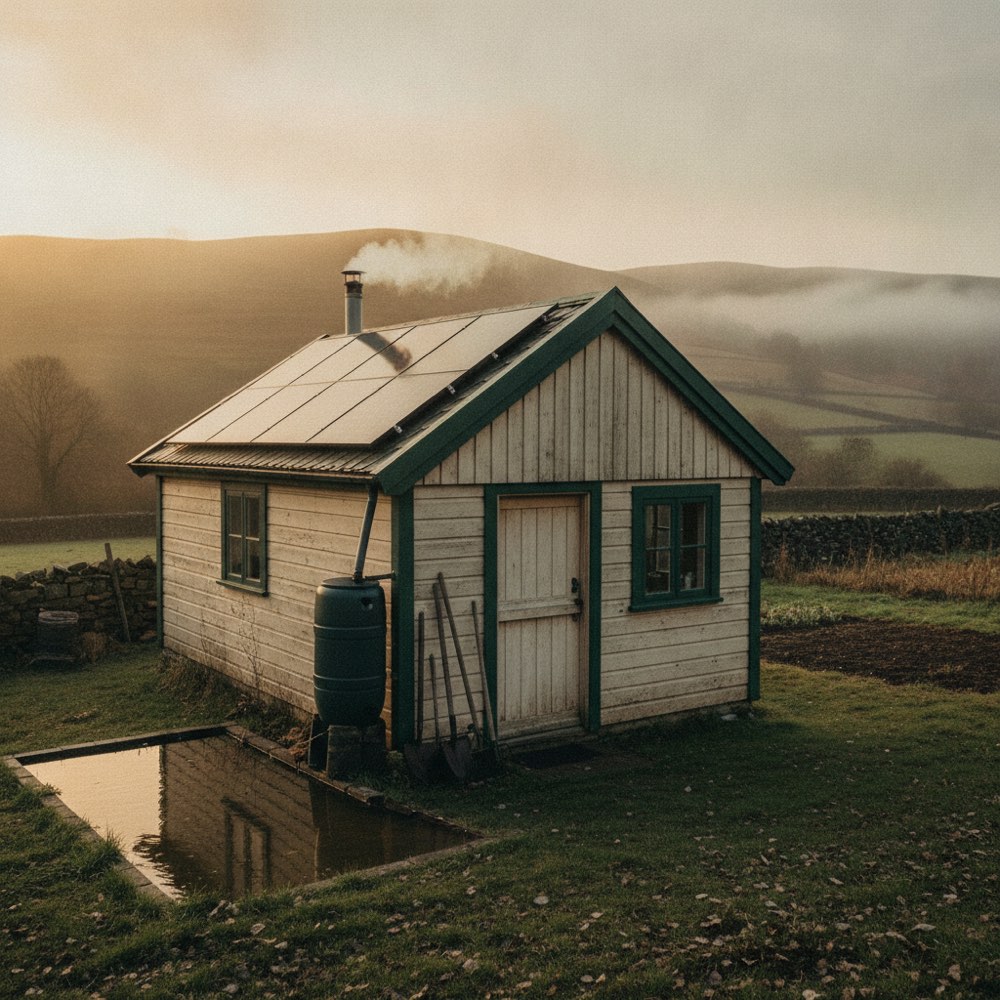
Every off grid power system in Britain, from a camper's single panel to a smallholding's full installation, is the same four blocks: something that generates, something that stores, something that converts, and the wiring that ties it together. Get the blocks sized to your real consumption and a UK off grid system is dependable, quiet and surprisingly ordinary to live with. Get them sized to a summer daydream and January will present the bill. This guide explains the architecture in plain English, gives honest UK numbers for solar and wind, and works a small cabin example through the actual maths.
The four blocks of an off grid power system
Strip the jargon away and every system looks like this:
- Generation: solar panels almost always, wind occasionally, a fuel generator as the backstop. This is your income.
- Storage: a battery bank, because generation and consumption never happen at the same time. This is your bank account, and in the UK it does most of the work.
- Conversion and control: a charge controller between panels and battery, and an inverter turning 12, 24 or 48 volts DC into 230V mains for ordinary appliances. These are the components that protect everything else.
- Distribution and protection: cables sized to the current, fuses on everything, and a shunt monitor so you actually know your state of charge.
Two formats exist for the same blocks. Separates, where you choose each component, cost less per kilowatt hour and scale properly, which is why permanent installs use them. All-in-one units, the portable power stations and solar generators we cover elsewhere, bundle battery, inverter and controller in one box: ideal for weekend cabins, backup and learning your numbers before committing to a built system.
Before sizing anything, write the consumption budget: every load, its watts, its daily hours. The whole design flows from that one honest list, as the off grid living pillar keeps repeating, because it is the step everyone skips.
Solar power in the UK: honest numbers, not brochure numbers
Solar is the right first choice for UK off grid generation: silent, maintenance-light, and cheap per watt by historical standards. But its output here is violently seasonal, and system design is really the art of handling that curve.
- A well-sited, unshaded south-facing panel in southern Britain produces, over a year, roughly 850 to 950 watt hours per year for each watt of panel, a touch less in the north.
- The seasonal split is the sting: a 100W panel might average 400 to 500Wh a day across June and July, and 60 to 100Wh a day in December. Midwinter output is commonly a fifth to an eighth of midsummer, and a run of thick overcast days can halve the December figure again.
- Orientation and shading dominate everything else. A panel flat on a van roof loses noticeably against a tilted one in winter when the sun barely climbs; a panel shaded by a single chimney for part of the day can lose more than its spec sheet ever admits.
The design consequence is simple to state: size solar for spring and autumn, not December. Covering your January consumption with panels alone means buying five to eight times your summer requirement, which is money better spent on a battery bank and a backup source. This is the same winter arithmetic that drives our solar generator guide, and it is the single most important fact in UK off grid design.
Wind and hydro: the honest assessment
Wind looks like the perfect partner for UK solar, strongest exactly when solar is weakest. For a minority of sites, it is. For most, small wind turbines are the most regretted purchase in off grid Britain, and it is worth understanding why before spending.
- Wind power rises with the cube of wind speed, so a turbine in a genuinely windy spot produces several times what the same turbine makes in a merely breezy one. Average speeds below roughly five metres per second make small turbines a poor use of money, and most inland, sheltered or low-mounted sites are below that.
- Turbulence is the killer. Buildings and trees churn the airflow near the ground; small turbines mounted on houses or short poles sit entirely inside that turbulence, producing little and wearing fast. Height and open fetch, coastal, moorland and hilltop sites, are what make wind work.
- Moving parts mean maintenance, which solar simply does not have.
The honest rule: solar first everywhere; wind as a complement only on exposed sites with real measured wind, ideally after a winter of actually logging it. Micro hydro is the opposite story: the rare sites with a year-round stream and usable drop get continuous day-and-night generation that transforms off grid life, but abstraction and environmental rules apply, so it is a specialist path with Environment Agency involvement.
Storage: the block that does the real work
In Britain the battery bank, not the solar array, is the heart of the system, because our weather delivers generation in lumps and consumption in a steady stream. Three storage formats cover the field:
- LiFePO4 leisure batteries are the default for vans, boats, cabins and small homes: thousands of cycles, 80 to 90 percent usable capacity, and modular growth from one battery to a bank. Our leisure battery guide compares the current amazon.co.uk-verified picks and explains the winter charging rules. Check price on Amazon
- Portable power stations package storage with inverter and charging in one box. Right answer for part-time use and backup; cost per kilowatt hour is higher than separates.
- Home battery systems (the wall-mounted, high-voltage class) belong to larger installations and professional installs, usually where a property is going fully off grid with multi-kilowatt loads.
Sizing rules that survive contact with reality
- Store two to three days of consumption where solar is your main source. One day of autonomy means the first dark spell forces the generator on; more than three days is usually dearer than a backup source.
- Choose system voltage by scale: 12V suits vans, boats and small cabins; 24V or 48V cut current and cable size once daily use passes a few kilowatt hours or inverter loads pass about 1.5kW continuously.
- Standard LiFePO4 must not charge below zero degrees: insulated installs, self-heating batteries or low-temperature cut offs are the three answers, and you should know which one your system uses.
Inverters, controllers and the components that protect your money
The charge controller
Panels never connect straight to batteries. An MPPT controller converts panel voltage to battery voltage efficiently and enforces the charge profile; it typically harvests meaningfully more than older PWM types in UK conditions, especially winter, and is the component not to economise on. Size it to the array's current with a margin, and set it to a LiFePO4 profile for lithium banks.
The inverter
The inverter sets your mains ceiling, and three numbers matter:
- Continuous watts: must exceed the biggest realistic combination of loads. A kettle alone is 2 to 3kW, which is why off grid households boil water on gas and keep inverters modest.
- Surge rating: motors and pumps draw multiples of their running watts for a moment at start-up.
- Idle draw: the quiet budget-killer. An inverter burning 20W doing nothing consumes nearly 500Wh a day, which in winter can exceed your entire solar harvest. Buy low idle draw, and switch the inverter off when unused.
Buy pure sine wave only; modified sine units damage or upset electronics and motors and save little. And run what you can on DC directly: 12V compressor fridges, LED lighting and USB charging skip the inverter's conversion losses entirely, which is why good van and boat systems feel bigger than their numbers.
Protection
Fuses or breakers on every battery feed, cable sized to current and length, and a shunt-based battery monitor so state of charge is a measured fact rather than a guess. These items cost little and are the difference between a system and a hazard.
When a generator still earns its place
Nobody romanticises a petrol generator, and nobody sensible designs a UK off grid system without some version of one. The arithmetic is the reason: covering the darkest fortnight of the year with solar means buying several times the array and bank you need for the other eleven and a half months. A small generator run for an hour or two during dark spells replaces thousands of pounds of oversizing.
- Its real job is battery charging, not running the house: run it through a proper mains charger at high output, then enjoy silence while the battery feeds the loads. An inverter generator is quieter, lighter and kinder to electronics than a traditional open-frame set.
- Boats often use the main engine with a B2B charger as the winter generator; smallholdings may justify a fixed diesel set with auto-start.
- The safety line is absolute: generators live outdoors, full stop, away from openings, with fuel stored properly. Exhaust in an enclosed space kills, the same carbon monoxide discipline that runs through our off grid heating guide.
A generator that runs thirty hours a year is not a failure of your solar design. It is the cheapest component in the system doing exactly its job.
Worked example: powering a small UK cabin
A one-room insulated cabin, lived in by two people, heated by wood (electric heating off grid is a non-starter, as the cost guide explains). First, the honest consumption budget:
- 12V compressor fridge: about 45W running, roughly half duty cycle = 500Wh/day
- LED lighting, four fittings, five hours of evening = 60Wh/day
- Two laptops worked and charged = 300Wh/day
- Phones, router or mobile hub = 120Wh/day
- Water pump, kettle-moments on the inverter for a blender or tools, margin = 220Wh/day
Total: about 1,200Wh (1.2kWh) a day.
Sizing the blocks
- Battery: 1.2kWh x 2.5 days autonomy = 3kWh usable, which at LiFePO4's usable depth means roughly 3.5 to 4kWh nominal: one 300Ah-class 12V battery or three 100Ah in parallel.
- Solar: in April to September, 800W of well-tilted panel comfortably exceeds 1.2kWh most days and refills the bank after dull spells. In December that same 800W may average only 500 to 700Wh a day: a deficit, by design.
- Winter plan: trim consumption (the fridge becomes nearly unnecessary in a cold porch, lights stay LED, laptops charge during the brightest hours), accept the battery cycling deeper, and run a small inverter generator through a 30A charger for about two hours every few days when the monitor reads low. Perhaps 25 to 40 generator hours a year.
- Conversion: a 40A MPPT controller, a 1,000 to 1,500W pure sine inverter with low idle draw, DC circuits for fridge, lights and USB.
That system, sized from measured need, delivers year-round power with winter discipline rather than winter misery, and every block of it can grow later: more panel, a second battery, a bigger inverter. Start with the budget list, not the shopping list.
Your questions, answered
What do you need for an off grid power system in the UK?
Four blocks: generation (solar panels, occasionally wind, a backup generator), storage (a LiFePO4 battery bank sized for two to three days of your consumption), conversion (an MPPT charge controller and a pure sine wave inverter) and protection (fuses, correct cabling and a shunt battery monitor). Size all of it from a written list of your daily watt hours.
Is solar power viable off grid in the UK?
Yes, with winter honesty. A watt of well-sited panel yields roughly 850 to 950 watt hours over a UK year, but December output is commonly a fifth to an eighth of June's. Workable systems size solar for spring and autumn, store two to three days in batteries, and cover midwinter deficits with reduced consumption and a small generator rather than an enormous array.
Are small wind turbines worth it in the UK?
Only on genuinely exposed sites: coastal, moorland or hilltop locations with real measured wind and the turbine mounted high in clean airflow. Power rises with the cube of wind speed, so sheltered and roof-mounted turbines produce very little and wear quickly. For most households solar plus batteries plus a generator beats wind on cost and reliability.
What size inverter do I need off grid?
Match it to your largest realistic combination of simultaneous loads, not to the biggest appliance you can imagine. Many vans and cabins live happily on 1,000 to 1,500W pure sine inverters by keeping kettles and heaters on gas and wood. Check surge capacity for pumps and motors, and favour low idle draw, because a wasteful inverter can quietly consume more than your winter solar harvest.
How many solar panels and batteries for a small cabin?
A two-person cabin using about 1.2kWh a day is well served by roughly 800W of tilted solar, 3.5 to 4kWh of LiFePO4 storage (one 300Ah-class battery or three 100Ah), a 40A MPPT controller and a modest pure sine inverter, with a small generator covering dark midwinter spells. Scale the numbers linearly from your own measured consumption.
Do I still need a generator with solar and batteries?
In the UK, almost always yes, and it is good design rather than failure. Covering the darkest weeks with solar alone means paying for five to eight times your summer capacity. A small inverter generator run occasionally through a proper battery charger replaces that oversizing at a fraction of the cost. Run it outdoors only, never in or near enclosed spaces.
Can an off grid system run electric heating?
Not realistically at household scale. A single 2kW heater running one evening consumes more than most off grid systems generate in a winter week. Off grid heat in the UK comes from wood, LPG or diesel appliances, with electricity reserved for lights, electronics, refrigeration and pumps. Our off grid heating guide covers the options and the carbon monoxide safety rules.