Off Grid Living UK: The Honest Complete Guide 2026
Last updated: 21 October 2026
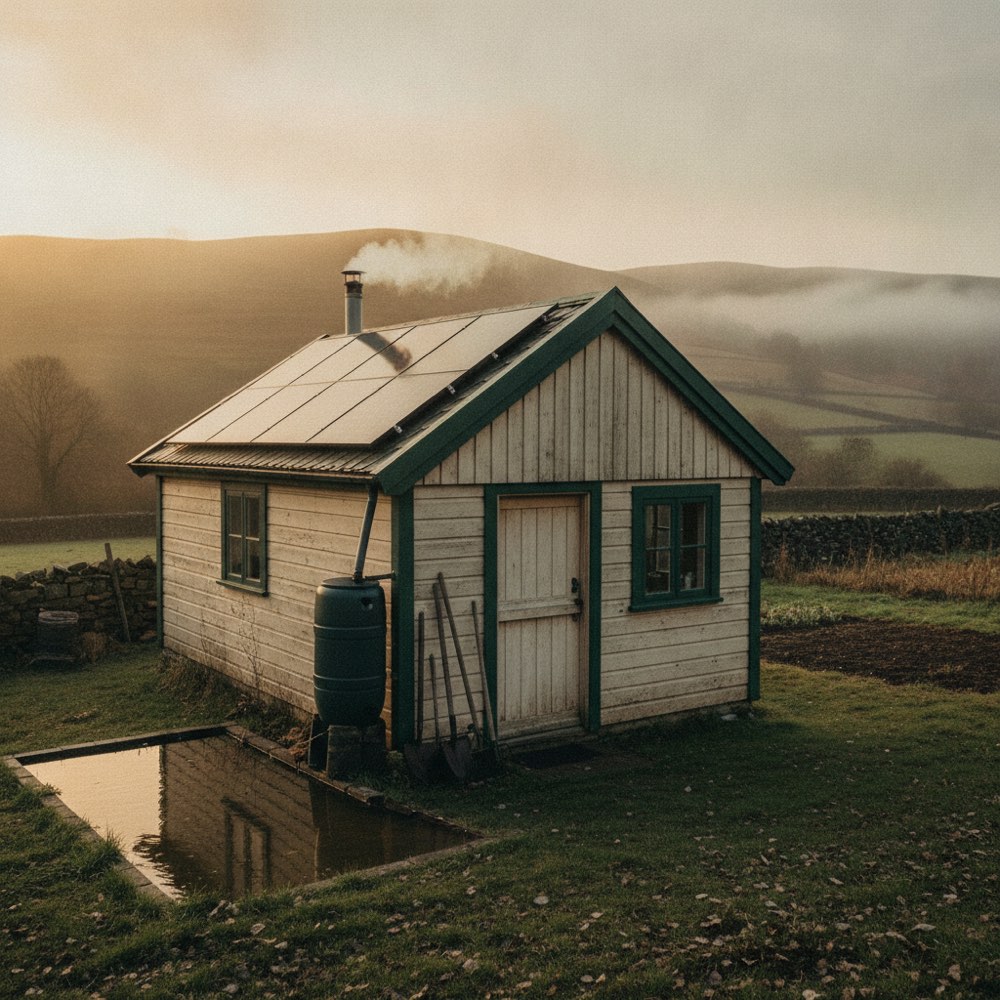
Off grid living in the UK is real, legal in the right circumstances, and quietly practised by thousands of people on smallholdings, narrowboats, in woodland cabins and converted vans. It is also nothing like the version sold on Instagram. Britain has weak winter sun, strong planning law, cold wet weather for half the year and council tax that follows you almost everywhere. This guide is the honest map: what off grid actually means here, the routes that genuinely work, how power, water, heat and waste fit together, and the questions to answer before you spend a penny on land or kit.
What off grid living actually means in the UK
Off grid is not one thing. It is a spectrum, and almost nobody in Britain lives at the extreme end of it. At one end sits a normal rural home with its own backup power, stored water and a wood stove, still connected to the mains but able to run without it. In the middle sits the smallholding or rural property that has deliberately dropped one or more utilities: a private water supply, a septic tank, solar and batteries instead of a grid connection. At the far end sit the full-time cabin dwellers, narrowboaters and van lifers who carry or generate everything they use.
The useful definition is this: off grid living means your household does not depend on one or more mains utilities, by choice or by location, and you have working systems in their place. By that definition, a boater on a continuous cruising licence is off grid. So is a Welsh One Planet smallholder. So, in a meaningful partial sense, is a Yorkshire farmhouse with a borehole, a septic tank and a battery bank that treats its grid connection as a backup rather than a lifeline.
That spectrum matters because the sensible way into off grid living in the UK is almost always to move along it gradually, not to leap to the far end. Each step teaches you what your household actually consumes, and each step is reversible.
The four pillars every setup must answer
- Power: generation, storage and distribution. Covered in depth in our off grid power systems guide.
- Water: sourcing, storing and treating it. Our emergency water pillar covers storage and treatment methods that scale up to off grid use.
- Heat and cooking: the hardest pillar in a UK winter. See off grid heating options and heating, cooking and lighting off the mains.
- Waste: toilets, grey water and rubbish. The least glamorous pillar and the one most often done badly.
The realistic routes into off grid living in Britain
There are five routes that genuinely work in the UK. Each has a different balance of cost, legality and comfort.
1. The resilient rural home (partial off grid)
Keep the mains connection, but build the capability to live without it: solar panels with battery storage, a wood or multi-fuel stove, stored water, a well-stocked larder. This is the route with no planning battles, no land purchase and no lifestyle shock, and it is where most people should start. A solar generator or portable power station gets you a working first layer of power independence in an afternoon.
2. The smallholding
A house with land, usually several acres, running private water, private drainage and some or all of its own power, often with food production on top. The catch is price: residential property with land carries a heavy premium, and bare agricultural land does not come with the right to live on it. The legal side is covered honestly in our guide to the law on living off grid in the UK.
3. The cabin or low-impact dwelling
The dream route and the hardest one legally. A permanent dwelling in open countryside needs planning permission, which is rarely granted, with the notable exception of the One Planet Development policy in Wales for applicants who can meet its strict self-sufficiency tests. Temporary and seasonal use of land is a different matter, with limited permitted development rights that we unpack in the legal guide.
4. The narrowboat
Arguably the most established off grid life in Britain. Roughly thirty thousand people live afloat, many without a home mooring under a continuous cruising licence, which requires genuine movement and limits stays in one spot to 14 days. Boats concentrate every off grid discipline into a steel tube: solar and leisure batteries for power, a stove for heat, water tanks filled at service points, cassette or compost toilets.
5. The van or motorhome
The cheapest entry and the least settled. A converted van teaches you more about your real energy and water consumption in a month than a year of reading. The limits are legal (nowhere in the UK grants a general right to park and live long term) and physical (small battery, small water tank, thin walls in January).
Off grid power in the UK: the short honest version
Solar works in Britain, but it is brutally seasonal. A panel that produces four or five times its rated capacity in daily watt hours in June might manage well under one times its rating per day in December. Any off grid power plan that only works in summer is not a plan, it is a holiday.
The working pattern for UK off grid power is therefore: a solar array sized for the shoulder seasons, a battery bank deep enough to ride through two or three dark days, and a backup source for midwinter, which usually means a generator run occasionally to recharge the batteries, or a wood stove carrying the heating load so electricity only has to cover lights, devices and refrigeration.
- Generation: solar first, wind only on genuinely exposed sites. Honest numbers in our off grid power systems guide.
- Storage: LiFePO4 leisure batteries are now the default for boats, vans and cabins. See the best leisure batteries for off grid use.
- All-in-one option: for a cabin used at weekends, or the first stage of a bigger build, a solar generator bundles panels, battery and inverter into one box with no wiring skills needed.
The single most useful exercise before buying anything: write down every electrical thing you intend to run, its wattage and its hours per day, and add it up. Most households are shocked twice, first by how much they currently use, then by how little they actually need.
Water off the mains: sourcing, storing, treating
Water is the pillar people underestimate. A UK adult uses roughly 140 litres a day on the mains; a disciplined off grid household gets by on 20 to 50 litres a day per person, and every one of those litres has to come from somewhere and go somewhere.
Where it comes from
- Private borehole or well: the gold standard for a settled site, giving mains-like supply once installed. Abstraction under 20 cubic metres a day does not need a licence in England, though private supplies used for drinking fall under the Private Water Supplies Regulations and your council can test them.
- Rainwater harvesting: Britain's one generous resource. A modest roof collects tens of thousands of litres a year. Fine for washing and garden use as collected; for drinking it needs proper filtration and treatment.
- Carted water: boats and vans fill tanks at taps and service points. It works, and it teaches ruthless economy.
Storing and treating it
Storage containers, gravity filters and purification methods are covered in detail in our emergency water hub, and everything there scales up: the same food-grade containers, gravity filtration and treatment discipline apply to a cabin as to a power cut. The rule that matters is separation: rainwater and untreated sources are kept apart from treated drinking water, always, with no shared containers and no exceptions.
Heat, cooking and light: the winter test
Heating is where UK off grid plans live or die, because the heating season here runs six months or more and electric heating from batteries is a non-starter at off grid scale. A single 2kW electric heater running all evening would flatten a battery bank that cost as much as a small car.
The honest hierarchy is:
- Insulation first. Every pound spent keeping heat in beats a pound spent making more heat. This is doubly true for vans, boats and cabins where surface-to-volume ratios are terrible.
- Wood or multi-fuel stove as the primary heat source for anything with a flue. New stoves must meet Ecodesign requirements, and smoke control areas add fuel and appliance rules. The full picture, including the regulations and carbon monoxide safety law, is in our off grid heating options guide.
- LPG for cooking almost universally, and for heating where a stove is impractical.
- Diesel heaters for vans and boats, where they have become the modern default for background heat.
Cooking and lighting without mains power are covered room by room in our off-mains heat, cooking and light guide. The one non-negotiable across all of it: every space with a fuel-burning appliance gets a carbon monoxide alarm to BS EN 50291, ventilation stays open, and flues get swept. Combustion in small spaces is unforgiving of shortcuts.
Waste: the pillar nobody photographs
No mains drainage means you own your waste, legally and practically.
- Compost toilets are the off grid default for cabins, boats and vans: simple urine-diverting designs work reliably if managed properly, and the solids compost down over a year or more. They are legal, but the output must be handled responsibly on your own land.
- Cassette toilets (boats and vans) are emptied at designated disposal points. Unromantic, dependable.
- Septic tanks and sewage treatment plants serve settled off grid homes. In England these are regulated under the general binding rules: discharges must meet the rules or require a permit from the Environment Agency, and septic tanks cannot discharge directly to a watercourse. Check the current rules on gov.uk before installing or buying a property with one.
- Grey water (washing-up, shower water) can usually be managed with soakaways and sensible soap choices, but volume and detergent discipline matter.
- Rubbish: you still pay council tax in most off grid situations, and collection may or may not reach you. Rural off gridders become aggressive reducers and recyclers out of pure practicality.
Is it legal? The two-minute version
The single most misunderstood fact in UK off grid living: buying land does not give you the right to live on it. Residential use of land needs planning permission, and planning permission for new dwellings in open countryside is rarely granted. The main lawful routes are: buying an existing dwelling and taking it off grid (almost always fine), living afloat under a boat licence, the 28 day rule for genuinely temporary use of land, caravan and mobile home rules in specific circumstances, and the One Planet Development policy in Wales for committed low-impact smallholders.
Council tax, meanwhile, follows habitation, not utilities. Going off grid does not take you off the council tax register.
We cover all of this properly, with citations to the legislation and official guidance, in is it legal to live off grid in the UK. Read it before you look at a single plot of land.
What off grid living costs: the honest frame
The folklore says off grid is cheap. The truth is that it is capital heavy and running cost light. You pay up front for land or a boat, for solar and batteries, for a stove and flue, for water and waste systems, and in exchange your monthly bills shrink dramatically. The trap is underestimating the up front side and the slow drip of maintenance: batteries age, flues need sweeping, generators need servicing, boats need blacking and surveys.
The other truth: the cheapest route in is not land, it is a boat or a van, and the most expensive mistake is buying bare land on the assumption that permission to live on it will follow. It usually does not.
We reason through land, systems, running costs and the comparison against mains living, in bands rather than invented price tags, in our off grid living cost guide.
Off grid reality vs the Instagram version
The version you see online is golden-hour footage of cabin porches and van doors opening onto Scottish lochs. The version you live is different, and it is worth stating plainly, not to put you off, but because the people who thrive off grid are the ones who wanted the real thing.
- Winter is the whole game. Anyone can live off grid in a British June. The test is the seventh consecutive grey day in January, when the solar yield is a rounding error, the wood pile is your central heating, and the water in the hose has turned solid.
- It is physical. Wood does not split itself. Water tanks do not fill themselves. Every convenience the grid silently provided becomes a chore with your name on it.
- It is administrative. Planning rules, licences, insurance, council tax, waste rules. The paperwork does not stop because you live in a cabin.
- It is genuinely rewarding. People who do it well report something the mains never gave them: a complete, legible understanding of their own consumption, real skills, lower bills and a life where the systems that keep them alive are ones they built and understand.
The failure mode is almost always the same: too much romance, too little arithmetic. The success mode is the reverse.
Who off grid living suits, and who it does not
It suits people who like systems and maintenance, who are honest about their energy use, who can live with less convenience in exchange for more independence, and crucially, households where everyone is on board. It suits retirees with capital and time, remote workers with modest power needs, and practical couples who have already tested themselves with a van or a winter of deliberate frugality.
It does not suit people who need high and constant electrical power (serious electric heating, power tools all day, energy-hungry medical equipment without redundancy), people who hate upkeep, or anyone expecting it to be a money-saving hack with no lifestyle change. For them, the resilient rural home route, mains-connected but capable, delivers most of the benefit with none of the hardship.
A sensible first-year plan
- Months 1 to 3: audit your real consumption. Measure, do not guess.
- Months 3 to 6: build the first power layer at home: a power station or solar generator, a heat source that works without mains, stored water. Live on it for a weekend, then a week.
- Months 6 to 12: rent the life before buying it. Hire a narrowboat in November. Book an off grid cabin in February. Borrow a van in the rain.
- After that: you will know which route fits, and the money you spend will be spent once, on the right things.
Your questions, answered
Is off grid living actually possible in the UK?
Yes, and thousands of people do it on narrowboats, smallholdings, in cabins and vans. What is hard is not the living, it is the law and the winter. Residential use of land needs planning permission, and UK winter solar yield is a fraction of summer, so every workable setup pairs solar and batteries with a wood or fuel-based heat source and usually a backup generator.
Can I just buy land and live on it off grid?
No. Owning land does not grant the right to live on it. Using land as a residence is a material change of use that needs planning permission, which is rarely granted for new dwellings in open countryside. The lawful routes are existing dwellings, boats, limited temporary use, certain caravan situations, and the One Planet Development policy in Wales. Our legal guide covers the detail with official sources.
Do you still pay council tax living off grid?
In almost all cases, yes. Council tax attaches to dwellings and to residential use, not to utility connections. Off grid homes, residential caravans and even boats with a permanent residential mooring can be liable. Disconnecting from the grid does not remove the liability.
What is the cheapest way to start living off grid in the UK?
A narrowboat or a converted van, by a wide margin. Both cost a fraction of land plus a lawful dwelling, both are legal with the right licence and insurance, and both teach you your real power, water and heat consumption before you commit serious money to a settled site.
How much solar do you need to live off grid in the UK?
It depends entirely on consumption, but the honest rule is to size for winter, not summer. A December day in Britain can yield under one hour of equivalent full sun, so a setup that covers a 2kWh daily budget in June may deliver a quarter of that in midwinter. Most full-time setups combine a generously sized array, a battery bank covering two to three days, and a generator or stove carrying winter loads. Our off grid power systems guide works through the maths.
Is off grid living cheaper than normal living?
Monthly running costs are usually much lower, but the capital costs are substantial and the comparison depends on what you count. Land, systems, maintenance and battery replacement over a decade narrow the gap considerably. It is better understood as trading bills for capital and labour than as a straight saving.
What happens in winter when there is no sun?
You plan for it. UK off grid households get through winter with a battery bank sized for several dark days, heating from wood or fuel rather than electricity, ruthless reduction of electrical loads, and a backup generator run for an hour or two when the batteries run low. Solar still contributes on bright winter days, but nobody sensible depends on it in December.
Sources
- The Town and Country Planning (General Permitted Development) (England) Order 2015, Schedule 2 Part 4 Class B (temporary use of land)
- Welsh Government, Technical Advice Note 6: One Planet Development practice guidance
- Canal and River Trust: continuous cruising boat licence guidance
- GOV.UK: general binding rules for small sewage discharges in England
- GOV.UK: licences to abstract water (over 20 cubic metres a day)
- GOV.UK: private water supplies regulation