Best Emergency Water Storage Containers UK (2026 Picks)
Last updated: 21 October 2026
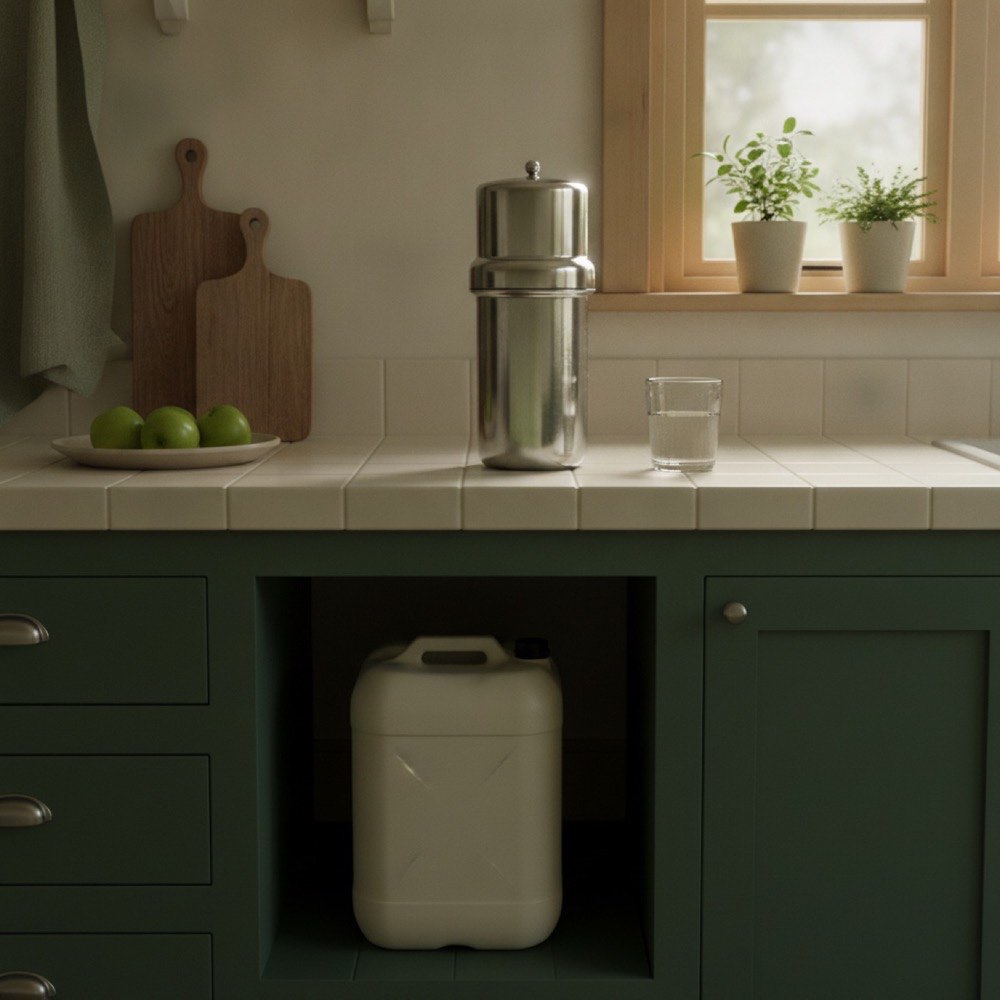
A burst main, a frozen pipe or a storm can take your taps out for days, and the official UK Prepare guidance is blunt about it: keep water at home. Sealed bottled water is the recommended baseline, but for cooking, washing and bulk cover, proper containers earn their cupboard space many times over. These are the best emergency water storage containers available on amazon.co.uk right now, from 25 litre food grade jerry cans to collapsible carriers for small flats, with honest notes on what each one is and is not good for.
| Pick | Model | Why | |
|---|---|---|---|
| Best overall 25L jerry can | Heavy Duty 25L Food Grade HDPE Jerry Can with DIN 61 Cap | This is the workhorse format for home water storage: tough food grade HDPE, a wide DIN 61 cap that seals properly and takes standard taps and pumps, and a stackable shape that sits flat in a cupboard or garage. Two of these cover a family of four for roughly three days of drinking and cooking water. {{AFF:25L water container food grade HDPE DIN 61 stackable|Check price on Amazon}} | Check price |
| Best with a tap | 25 Litre Water Container with Tap, UN Approved and Food Safe | A tap turns a storage container into a working kitchen supply during an outage: stand it on the worktop edge and you can fill kettles, pans and cups one handed without lifting 25 kg or unscrewing a cap each time. The UN approval is a packaging strength standard, which in practice means thick walls and a cap that does not weep. {{AFF:25 litre water container with tap food safe|Check price on Amazon}} | Check price |
| Best multi-pack for a full household store | ITP Packaging 6 x 25 Litre Blue Jerry Cans with Tamper Evident Caps | One hundred and fifty litres is a serious household store: at the 10 litres per person per day comfort figure the gov.uk Prepare campaign cites, this covers a family of four for nearly four days including cooking and basic hygiene. The blue colouring also admits less light than natural translucent plastic, which helps when your only storage spot gets some daylight. {{AFF:6 x 25 litre jerry can water tamper evident|Check price on Amazon}} | Check price |
| Best collapsible for flats and small homes | 20L Collapsible Water Container with Tap (Food Grade LDPE) | If you live in a flat with one cupboard to your name, rigid cans are a hard sell. A collapsible container folds to the size of a paperback until the day a supply interruption is announced, then holds 20 litres filled from the tap before the water goes off. It is the single most space-efficient way to add surge capacity to a small home. {{AFF:20L collapsible water container with tap food grade|Check price on Amazon}} | Check price |
| Best for carrying | Unibos 25L Heavy Duty Water Container, Food Grade | If your plan involves fetching water from a bowser or a relative's house rather than storing everything at home, the carrying handle and pouring spout matter more than stackability. This is the one to keep in the car boot alongside your kit. {{AFF:Unibos 25 litre water container food grade|Check price on Amazon}} | Check price |
What makes a good emergency water storage container
Four things separate a container you can trust from a cheap drum that ruins your water. First, the material must be food grade: a plastic approved for contact with drinking water, usually HDPE (resin code 2) or LDPE (code 4). Second, the cap must seal properly; tamper evident and DIN 61 screw caps are the standards to look for. Third, the size has to match your strength and your home, because water weighs one kilogram per litre and a full 25 litre can is a 25 kg lift. Fourth, the container should either be opaque or live somewhere dark, since light encourages algae in stored water.
Everything in this roundup was checked as currently listed on amazon.co.uk. We have covered the standard that matters most, the food grade claim itself, in a separate guide to food grade water storage containers, including how to verify a listing before you pay.
25 litre water jerry cans: the backbone of a UK home store
The 25 litre jerry can is the sweet spot for most UK homes. One can holds roughly three days of drinking and cooking water for two adults at the World Health Organization survival figure of 2.5 to 3 litres per person per day, yet it still fits under the stairs or at the bottom of a wardrobe. The format is cheap, widely stocked, and built to a packaging standard rather than a camping accessory standard, which shows in the wall thickness.
The one rule with 25 litre cans: fill them where they will be stored. Carrying 25 kg of water up a staircase is how containers get dropped and backs get hurt. Set the empty can in its final position, fill it with a hose from the cold kitchen tap or with a jug, and label it with the fill date.
Stackable water containers: making the most of cupboard space
Proper stackable cans have moulded, interlocking tops and bases so a second can sits securely on the first. That doubles what a single cupboard footprint can hold, which matters in UK homes where storage space is the real constraint, not budget. The DIN 61 cap models are the ones to pick here, because the cap sits recessed rather than proud, so the stack stays level.
Stack no more than two high with full 25 litre cans, keep stacks on a solid floor, and put the oldest fill date on top so rotation stays easy. If your only stacking space is a garage or shed, read the temperature notes in our guide on how to store water long term first, because frost and summer heat both shorten the life of stored water.
WaterBrick style stacking bricks: the honest UK picture
American prepping sites rave about WaterBrick containers, the brick shaped 3.5 US gallon units that cross-stack like oversized building blocks. The honest UK picture: there is a WaterBrick listing on amazon.co.uk, but at the time of writing it shows as unavailable, and UK stock of the brand has been patchy for a long time. Importing from the US adds cost that is hard to justify.
The good news is that you lose very little by skipping them. UK-stocked stackable jerry cans give you the same interlocking storage at a lower cost per litre, with caps that take standard taps and pumps. If the brick format specifically appeals, check the listing for current stock before planning a store around it, and treat the stackable cans above as the dependable alternative.
Collapsible water containers for flats and small homes
Collapsible containers solve a different problem: no storage space at all. Folded, a 20 litre collapsible carrier takes up less room than a cereal box. The strategy is to keep two or three folded in a drawer, then fill them the moment you get warning of an interruption, whether that is a water company notice about planned works, a Met Office storm warning, or the first sign of a burst main in the street.
Their film walls will not survive years of knocks the way rigid HDPE does, and a punctured container mid-outage is worse than no container, so inspect them after each use. For a small home, the strongest setup is a hybrid: one rigid 25 litre can as the permanent store, plus collapsibles as surge capacity you fill on warning.
Tap or plain screw cap: which should you buy?
A tap makes stored water dramatically easier to use. During an outage you will be filling kettles, saucepans, cups and wash bowls dozens of times a day, and tipping a 25 kg can for each pour gets old by lunchtime. Stand a tap model on a worktop with the tap over the sink edge and it works like a temporary mains.
The trade-off is that every tap is an extra joint that can weep during months of quiet storage. The belt and braces answer is to store with the solid cap fitted and keep the tap in a labelled bag taped to the container, swapping it in when an outage starts. If you would rather not faff, buy one tap model for use and plain cap cans for the rest of the store.
How many containers does your household actually need?
The gov.uk Prepare campaign points to the World Health Organization figures: 2.5 to 3 litres of drinking water per person per day as the survival minimum, and about 10 litres per person per day to also cover basic cooking and hygiene. For a family of four planning three days of cover, that is 36 litres at minimum and up to 120 litres for comfort.
- Single adult: one 25 litre can covers drinking and cooking for over a week
- Couple: two 25 litre cans, or one can plus bottled water
- Family of four: two cans as the minimum, six for full comfort cover
The full working, including pets, babies and medical needs, is in our guide to how much water to store per person. Water should also sit alongside the rest of your supplies; see the UK emergency kit list for the complete picture.
Buying right: food grade claims and keeping the water drinkable
Two final rules before you order. First, only buy containers sold new and explicitly described as food grade or food safe; never press a second-hand drum into service, because you cannot know what it previously held, and HDPE absorbs traces of chemicals permanently. Our guide to food grade water storage containers explains exactly how to verify the claim from the listing and the markings on the base.
Second, a good container is only half the job. Official Prepare guidance recommends sealed bottled water as your core supply precisely because it is filled and sealed under controlled conditions, so treat containers as the bulk and backup layer on top of a bottled baseline. Then prepare, fill and rotate your containers properly, as covered step by step in how to store water long term in the UK, and the whole system starts from our pillar guide to emergency water in the UK.
The picks in detail
Best overall 25L jerry can: Heavy Duty 25L Food Grade HDPE Jerry Can with DIN 61 Cap
25 litre capacity, food grade HDPE, DIN 61 screw cap, stackable design, approx 29.4 x 24.5 x 47 cm
This is the workhorse format for home water storage: tough food grade HDPE, a wide DIN 61 cap that seals properly and takes standard taps and pumps, and a stackable shape that sits flat in a cupboard or garage. Two of these cover a family of four for roughly three days of drinking and cooking water. {{AFF:25L water container food grade HDPE DIN 61 stackable|Check price on Amazon}}
Worth knowing: No tap included as standard, and a full can weighs around 25 kg, so fill it where it will live rather than carrying it across the house.
Best with a tap: 25 Litre Water Container with Tap, UN Approved and Food Safe
25 litre capacity, dispensing tap included, UN approved packaging standard, food safe polyethylene
A tap turns a storage container into a working kitchen supply during an outage: stand it on the worktop edge and you can fill kettles, pans and cups one handed without lifting 25 kg or unscrewing a cap each time. The UN approval is a packaging strength standard, which in practice means thick walls and a cap that does not weep. {{AFF:25 litre water container with tap food safe|Check price on Amazon}}
Worth knowing: A tap is one more joint that can drip, so store it tap side up and test the seal when it arrives, before you rely on it.
Best multi-pack for a full household store: ITP Packaging 6 x 25 Litre Blue Jerry Cans with Tamper Evident Caps
Six 25 litre cans, 150 litres total, blue polyethylene, tamper evident screw caps
One hundred and fifty litres is a serious household store: at the 10 litres per person per day comfort figure the gov.uk Prepare campaign cites, this covers a family of four for nearly four days including cooking and basic hygiene. The blue colouring also admits less light than natural translucent plastic, which helps when your only storage spot gets some daylight. {{AFF:6 x 25 litre jerry can water tamper evident|Check price on Amazon}}
Worth knowing: Check you genuinely have the floor space and floor strength first: six full cans weigh around 150 kg, so spread them across more than one cupboard.
Best collapsible for flats and small homes: 20L Collapsible Water Container with Tap (Food Grade LDPE)
20 litre capacity, food grade LDPE with no BPA, folds flat when empty, dispensing tap
If you live in a flat with one cupboard to your name, rigid cans are a hard sell. A collapsible container folds to the size of a paperback until the day a supply interruption is announced, then holds 20 litres filled from the tap before the water goes off. It is the single most space-efficient way to add surge capacity to a small home. {{AFF:20L collapsible water container with tap food grade|Check price on Amazon}}
Worth knowing: Thin film walls are inherently less durable than rigid HDPE, so treat it as short-notice surge capacity rather than a permanent year-round store.
Best for carrying: Unibos 25L Heavy Duty Water Container, Food Grade
25 litre capacity, food grade plastic, built in carrying handle, pouring spout
If your plan involves fetching water from a bowser or a relative's house rather than storing everything at home, the carrying handle and pouring spout matter more than stackability. This is the one to keep in the car boot alongside your kit. {{AFF:Unibos 25 litre water container food grade|Check price on Amazon}}
Worth knowing: 25 litres is a two handed carry for most people once full; part-fill it if you need to move it any distance.
Your questions, answered
Are 25 litre jerry cans safe for drinking water?
Yes, provided the can is sold new and explicitly marked as food grade or food safe, which usually means food grade HDPE. Clean it before first use, fill it from the cold mains tap, and never reuse a can that has held fuel, chemicals or anything other than water.
How many 25 litre containers does a family of four need?
Two 25 litre cans cover the WHO survival minimum of around 3 litres per person per day for three days, with margin for cooking. For the more comfortable 10 litres per person per day that gov.uk cites, which includes basic hygiene, a family of four needs around 120 litres for three days, so five to six cans or a mix of cans and bottled water.
Can I store water containers in the garage or shed?
You can, but it is second best. Unheated outbuildings swing from sub-zero in winter, which can split a full rigid container as ice expands, to summer heat that accelerates algae and plastic taint. If the garage is your only option, leave some headspace for expansion, keep containers off sunny windows, and rotate the water more often.
Do I need a container with a tap?
For at least one container, it is worth it. A tap model works like a temporary mains during an outage, making kettles and pans easy to fill one handed. For containers that will sit in storage for months, a plain tamper evident screw cap has fewer joints to leak, so many households run one tap can and plain cap cans for the rest.
Can you buy WaterBrick containers in the UK?
Only intermittently. The WaterBrick listing on amazon.co.uk has been showing as unavailable, and UK stock of the brand is patchy. Stackable 25 litre jerry cans with DIN 61 caps give the same space-efficient stacking at a lower cost per litre and are consistently stocked by UK sellers.
How long can I keep tap water in these containers?
Filled correctly into a clean, sanitised, sealed food grade container, tap water is generally rotated every six months as standard emergency storage practice. The widely quoted 24 hour limit from UK water companies applies to an open jug in the fridge, not to sealed storage. Our long term storage guide covers the full method and rotation schedule.