Best Water Filter for Emergencies UK: Home Picks 2026
Last updated: 21 October 2026
When a burst main, a flood or a long power cut interrupts the water supply, a household filter turns stored or collected water into something you can safely drink. This roundup compares the main formats side by side: countertop gravity systems, squeeze filters and filter bottles, all confirmed as available on amazon.co.uk at the time of writing. It is written for home emergency use rather than wild camping, and it is honest about the one thing no mainstream filter advert likes to admit: what each type cannot remove.
| Pick | Model | Why | |
|---|---|---|---|
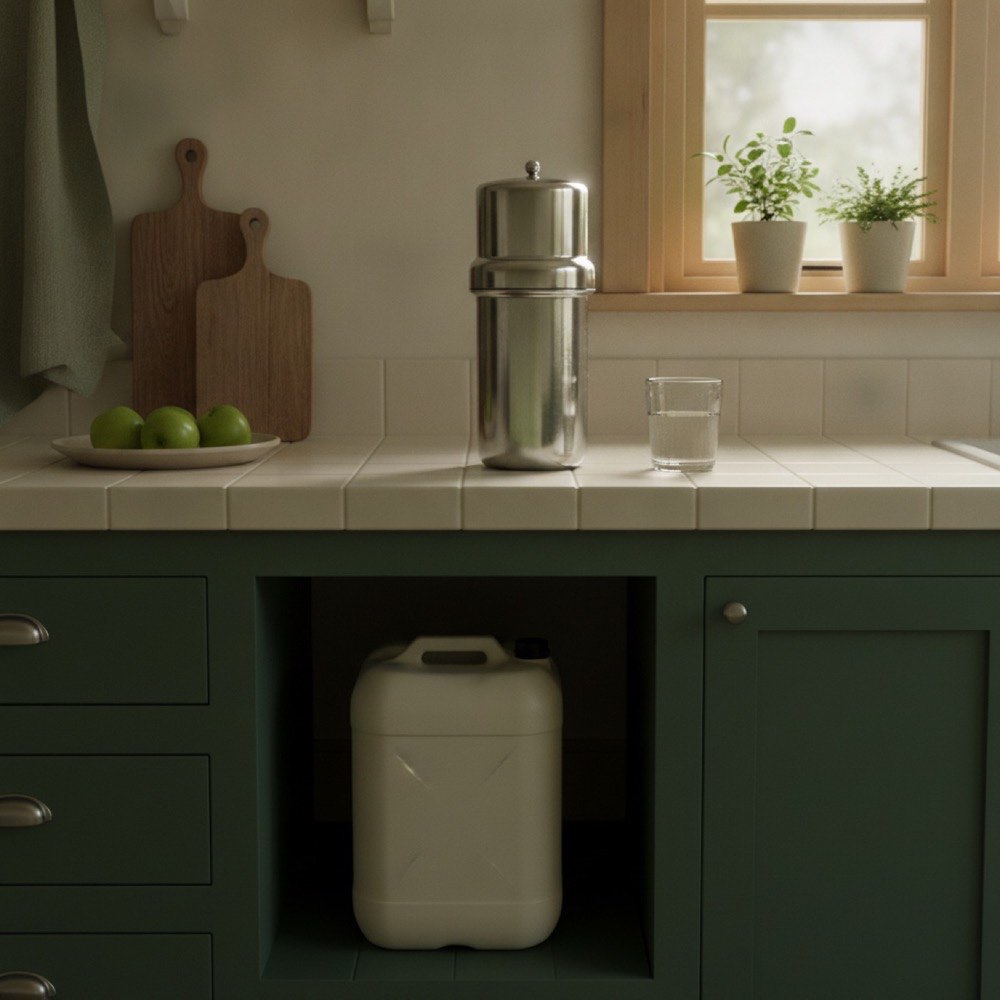
| Best Overall for Home Use | British Berkefeld 8.5L Ultra Sterasyl Gravity Water Filter System | For a stay-at-home emergency this is the format that makes sense: a large standing reservoir that processes water all day with no pumping, no squeezing and no power. Doulton publishes NSF test certification for the Ultra Sterasyl candles, with claimed reduction of bacteria and of Cryptosporidium and Giardia cysts above 99.99 percent, plus chlorine, lead and microplastics reduction through the carbon core. One fill covers a family of four for a day of drinking water. | Check price |
| Best Packable Gravity Filter | LifeStraw Peak Series Compact Gravity Water Filter System 3L | The halfway house between a countertop system and a pocket filter. Hang the 3L bag from a door handle or tree branch and gravity does the work, so it suits an evacuation bag, a caravan or a second home as well as a kitchen shelf. LifeStraw's published data claims 99.999999 percent bacteria reduction and 99.999 percent reduction of protozoan parasites including Cryptosporidium and Giardia. | Check price |
| Best Squeeze Filter | Sawyer Squeeze Water Filter System SP129 | The squeeze format earns its place in an emergency kit because it is fast and flexible: fill the pouch, squeeze clean water straight into a cup, or screw the filter onto a standard plastic bottle. The 0.1 micron absolute rating is tighter than most ceramic candles for bacteria and protozoa, and the included syringe lets you backflush the membrane and restore flow many times over its life. | Check price |
| Best Filter Bottle | Water-to-Go Classic 75cl Filter Bottle | The one pick here whose manufacturer publishes virus reduction claims, which matters if floodwater or sewage contamination is part of your planning. Water-to-Go is a British company and quotes independent laboratory testing for its three stage filter, with claimed reductions above 99.99 percent for viruses and 99.9999 percent for bacteria. As a grab-and-go option for each family member, a filter bottle is the simplest format there is: fill, close, drink. | Check price |
Why a water filter belongs in a UK emergency kit
Most UK water supply incidents are short and end with a boil water notice rather than a dry tap. But storms, floods and burst mains do cut supplies for days at a time, and during a long power cut many homes lose the easy ability to boil as well, because the kettle, the hob and in some homes the boiler all stop together. A filter that works with no power closes that gap: it turns stored water, delivered bottled water or collected rainwater into drinking water without burning fuel for every litre.
A filter is one layer of a plan, not the whole plan. Stored water comes first, because the easiest water to treat is the clean tap water you put aside before anything happened. Our guide to how much water to store per person covers the quantities, and the wider emergency water guide sets out the full picture for UK homes.
How we chose these emergency water filters
This is specification research, not laboratory testing. Every pick had to clear four checks. First, confirmed availability on amazon.co.uk at the time of writing. Second, published performance data: we only repeat reduction figures that appear in manufacturer data sheets or certification documents, and we say plainly where a claim is a manufacturer figure rather than third party certification. Third, running costs, meaning rated cartridge life and how easy replacements are to buy in the UK. Fourth, honest fit for home emergency use, which is a different job from ultralight hiking: capacity and ease of producing many litres a day count for more than weight.
We also deliberately picked one of each format rather than four near identical products, because the formats genuinely suit different situations, and many households sensibly own two.
Gravity vs squeeze vs bottle: which emergency water filter format fits your home
The format question matters more than the brand question.
Gravity systems: the household workhorse
A gravity filter processes water while you do something else, holds a useful reserve in its lower chamber, and asks nothing of you but topping up. For a family sheltering at home it is the obvious first choice. This roundup includes two sizes, but if you want the full comparison of countertop systems, candle types and the Berkey situation, that lives in our dedicated guide to the best gravity water filters in the UK.
Squeeze filters: fast, flexible, personal
A squeeze filter makes a litre in about a minute of effort and packs into a coat pocket. It suits the car, the evacuation bag and the household member who is away from home when disruption starts. Its weakness is volume: squeezing ten litres for a family every day is a chore.
Filter bottles: the simplest kit per person
A filter bottle needs no instructions beyond fill and drink, which makes it the right format for children's school bags, commuters and anyone who will not fiddle with pouches and syringes. Capacity is the limit: treat it as personal kit that buys time, not a household supply.
What emergency water filters remove, and what they do not
Here is the honest version of the claims table.
- Bacteria and protozoa: all four picks publish strong reduction claims for bacteria such as E. coli and for the cysts of Cryptosporidium and Giardia. This is what mechanical filtration does best, because these organisms are larger than the pore sizes involved.
- Viruses: hollow fibre and ceramic elements are not certified for virus removal, because waterborne viruses are smaller than their pores. Of these picks only Water-to-Go publishes virus reduction claims for its three stage media. Where sewage or floodwater is involved, add a rolling boil or chlorine dioxide tablets as a second barrier.
- Chemicals and metals: only elements with a carbon or similar media stage reduce chlorine, some pesticides and lead. The British Berkefeld candles and the Water-to-Go filter include such a stage. Plain hollow fibre membranes do not.
- Salt and serious chemical contamination: no filter in this class touches dissolved salt, fuel spills or industrial contamination. If the water smells of chemicals, no portable filter makes it safe.
The NHS and UKHSA position during contamination incidents is simple: follow the water company's notice, and where boiling is advised, bring water to a rolling boil and let it cool, which deals with bacteria, viruses and parasites in one step. A filter supplements that advice, it does not replace it. For the full method hierarchy see how to purify water in an emergency.
Building a layered emergency water plan
Professional guidance on drinking water in emergencies always layers methods, because every single method has a blind spot.
- Layer one, storage: clean tap water put aside in advance needs no treatment at all for days. Containers are covered in our emergency kit list.
- Layer two, filtration: one of the picks above handles turbidity, bacteria and parasites, and makes large volumes practical.
- Layer three, disinfection: a rolling boil where you can, or chlorine dioxide tablets where you cannot, deals with viruses that filters miss. Our guide to the best water purification tablets compares the options.
A sensible household setup is a gravity system in the kitchen, Check price on Amazon, a squeeze filter in the car or grab bag, Check price on Amazon, and a pack of tablets in the cupboard. That combination covers staying put, moving out and every realistic water source in between.
Looking after an emergency filter so it works when needed
A filter that has been stored carelessly can fail exactly when you need it, and the failure is invisible.
- Never let a wet hollow fibre filter freeze. Ice expands inside the fibres and splits them, and the filter will still pass water afterwards while no longer filtering properly. Once a LifeStraw or Sawyer membrane has been used, keep it indoors over winter, not in the car or shed.
- Dry before long storage. Backflush squeeze filters with clean water, let everything air dry fully, and store with the caps off so nothing grows inside.
- Pre filter cloudy water through a clean cloth or coffee filter to protect the element, whatever the format.
- Keep spares of the consumable part: ceramic candles for a countertop system, Check price on Amazon, or replacement cartridges for a bottle, Check price on Amazon.
Finally, run a few litres through any new filter when it arrives. You confirm it works, you learn how it handles, and first-run carbon dust rinses away before the day it matters. For where water treatment fits in the wider household plan, see how to prepare for a power cut.
The picks in detail
Best Overall for Home Use: British Berkefeld 8.5L Ultra Sterasyl Gravity Water Filter System
8.5L stainless steel housing, two Ultra Sterasyl ceramic candles at 0.9 micron absolute, candles rated to around 1,500 litres each, made in the UK by Doulton
For a stay-at-home emergency this is the format that makes sense: a large standing reservoir that processes water all day with no pumping, no squeezing and no power. Doulton publishes NSF test certification for the Ultra Sterasyl candles, with claimed reduction of bacteria and of Cryptosporidium and Giardia cysts above 99.99 percent, plus chlorine, lead and microplastics reduction through the carbon core. One fill covers a family of four for a day of drinking water.
Worth knowing: It is slow by design, so fill it before the situation bites rather than during it. No virus certification, so pair it with tablets or boiling where sewage contamination is possible. It is also the bulkiest option here.
Best Packable Gravity Filter: LifeStraw Peak Series Compact Gravity Water Filter System 3L
3L reservoir with hanging strap, 0.2 micron hollow fibre membrane, membrane rated by LifeStraw to around 2,000 litres, weighs a few hundred grams and rolls up small
The halfway house between a countertop system and a pocket filter. Hang the 3L bag from a door handle or tree branch and gravity does the work, so it suits an evacuation bag, a caravan or a second home as well as a kitchen shelf. LifeStraw's published data claims 99.999999 percent bacteria reduction and 99.999 percent reduction of protozoan parasites including Cryptosporidium and Giardia.
Worth knowing: No carbon stage, so taste is unchanged, and like every hollow fibre filter it makes no virus claims and is permanently damaged by freezing. The 3L capacity means more refilling than a countertop unit for a family.
Best Squeeze Filter: Sawyer Squeeze Water Filter System SP129
0.1 micron absolute hollow fibre membrane, includes squeeze pouches and cleaning syringe, threads onto standard soft drink bottles, maintained by backflushing
The squeeze format earns its place in an emergency kit because it is fast and flexible: fill the pouch, squeeze clean water straight into a cup, or screw the filter onto a standard plastic bottle. The 0.1 micron absolute rating is tighter than most ceramic candles for bacteria and protozoa, and the included syringe lets you backflush the membrane and restore flow many times over its life.
Worth knowing: Squeezing litre after litre for a household gets tiring, so treat it as the mobile companion to a gravity system rather than a replacement. No virus or chemical reduction claims, and freezing ruins the membrane.
Best Filter Bottle: Water-to-Go Classic 75cl Filter Bottle
75cl bottle with replaceable three stage filter, manufacturer claims reduction of viruses, bacteria, protozoan cysts, chemicals and microplastics, each filter rated to around 200 litres
The one pick here whose manufacturer publishes virus reduction claims, which matters if floodwater or sewage contamination is part of your planning. Water-to-Go is a British company and quotes independent laboratory testing for its three stage filter, with claimed reductions above 99.99 percent for viruses and 99.9999 percent for bacteria. As a grab-and-go option for each family member, a filter bottle is the simplest format there is: fill, close, drink.
Worth knowing: The 200 litre cartridge life is short next to the other picks, so budget for replacement filters. A 75cl bottle is personal kit, not a household supply. Manufacturer claims are not the same as NSF certification, so keep boiling or tablets in the plan for the worst sources.
Your questions, answered
What is the best water filter for emergencies in the UK?
For a household sheltering at home, a countertop gravity system such as the British Berkefeld 8.5L is the strongest choice because it processes large volumes with no power and holds a reserve. For a grab bag or car, a squeeze filter such as the Sawyer Squeeze or a packable gravity bag such as the LifeStraw Peak 3L makes more sense. Many households sensibly own one of each format.
Do emergency water filters remove viruses?
Most do not. Hollow fibre and ceramic filters physically block bacteria and parasites but their pores are larger than waterborne viruses, and manufacturers such as Sawyer and LifeStraw make no virus claims for these products. Water-to-Go publishes virus reduction claims for its three stage bottle filter. Where sewage or floodwater is involved, boil the filtered water or treat it with chlorine dioxide tablets as a second step.
Is it better to boil water or filter it in an emergency?
Boiling is the gold standard: NHS and WHO guidance is that water brought to a rolling boil is safe from bacteria, viruses and parasites once cooled. Filtering is better when fuel or power is short, when you need many litres, or when the water is cloudy. The strongest approach layers both: filter first for clarity and parasites, then boil or use tablets where viruses are a concern.
Can I use a camping water filter for home emergencies?
Yes, the technology is identical, but match the format to the job. A pocket hiking filter produces water slowly and in small amounts, which frustrates a family of four within a day. For home use, prioritise capacity: a gravity system as the base, with small filters as personal and mobile backups.
How long do emergency water filters last in storage?
Unused and sealed, hollow fibre filters and ceramic candles store for years; check the manufacturer's stated shelf life on the packaging. The rules that matter are to keep unused filters sealed and dry, to protect any used hollow fibre filter from freezing, and to dry used filters thoroughly before putting them away.
Will a water filter make floodwater safe to drink?
Treat floodwater as a last resort source. It can carry sewage, fuel and chemical runoff, and no portable filter removes dissolved chemicals or fuel. If floodwater is genuinely the only option, let it settle, pre filter it through cloth, run it through a filter, then boil it or treat it with tablets. Stored water and bottled water from the water company should always come first.
What is the difference between this roundup and the gravity filter guide?
This page compares formats for emergency home use: gravity against squeeze against bottle filters, one strong pick of each. The separate gravity water filter guide goes deep on countertop systems only, comparing candle types, capacities and running costs across that single category.